





N. inventario: IG 239289
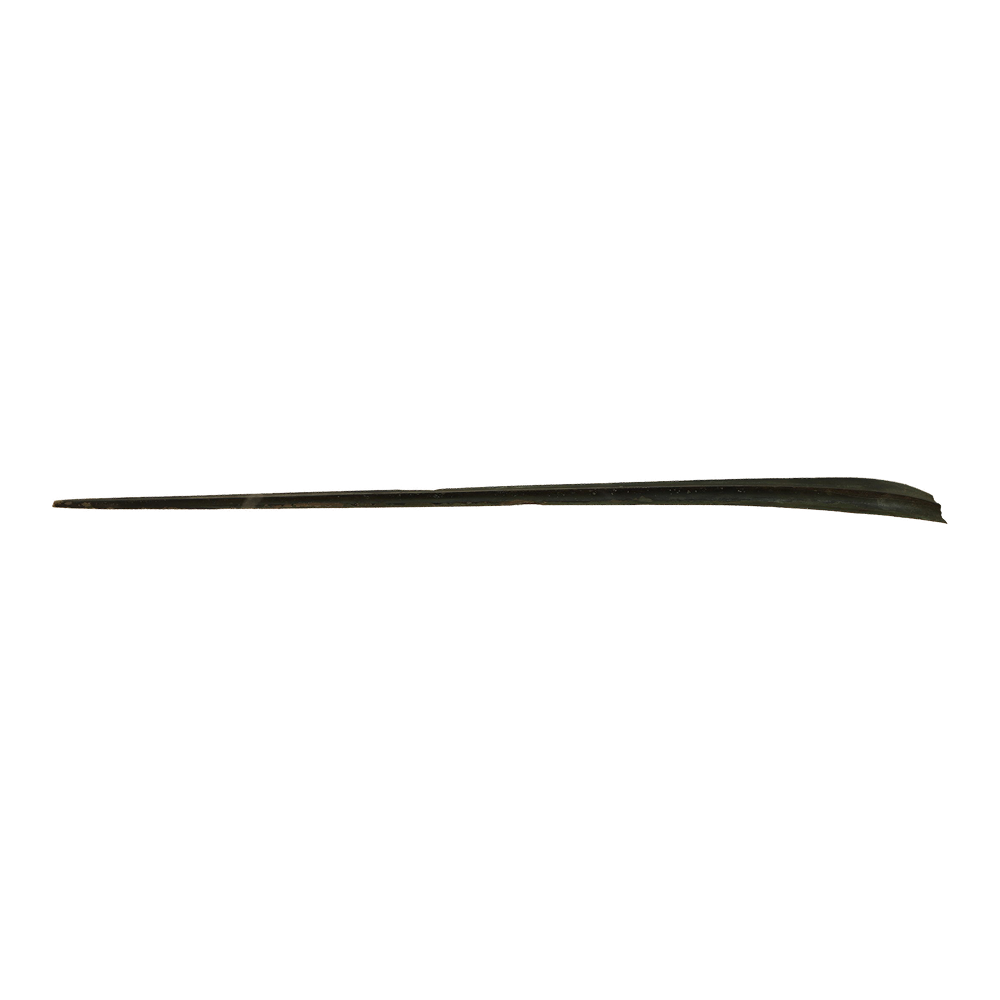
Sauerbrunn-type sword with simple tang and long ribbed blade. The tang and blade are decorated with burin-engraved motifs consisting of two inward-spiralling volutes representing a pair of eyes. The blade was attached to an organic hilt by means of two rivet holes secured with metal rivets.
| Teca |
Display case swords |
|---|---|
| Collocazione | Museum of the Bacchiglione River, Castello di San Martino della Vaneza, Cervarese Santa Croce (Province of Padua), Room XXX, Display case XXX |
| Data | 16th–15th century BC (Middle Bronze Age) |
| Materiale | Bronze |
| Misure | Length 64 cm - Width 3,5 cm |
This bronze sword, approximately sixty-four centimeters long, comes from the territory of Cervarese Santa Croce and was found along the course of the Bacchiglione River. It is now preserved at the Museo del fiume Bacchiglione, in the Castello di San Martino della Vaneza, and can be dated to between the 16th and 15th centuries BCE, during the Middle Bronze Age.
The weapon belongs to the Sauerbrunn type, a typology widespread in Central Alpine Europe and characterized by a simple, rounded, and expanded base. Two holes are present at the base for metal rivets, which were used to secure the handle, originally made of organic materials such as wood or bone. Just above the base, a slight narrowing connects the hilt to the blade, which develops in a slender and regular form.
The blade is particularly long and features a strongly pronounced central ridge with a triangular cross-section, which increased its structural strength. The decoration, executed with a burin, is concentrated mainly near the base: here two inward-rolled volutes appear, interpreted as a pair of stylized eyes. From this motif extend groups of incised lines, alternating with bands of dense transverse hatching, which accompany the development of the blade. The ornamentation continues along the edges with two initially parallel lines that gradually converge toward the central ridge as they approach the tip.
This decorative scheme was not merely aesthetic but also carried strong symbolic significance. The “eye” motif endowed the sword with a kind of vital, almost magical appearance, as if the weapon possessed its own identity. The idea that swords could accompany and protect their owner is well attested in mythological traditions and epic narratives, in which the most famous weapons often bear a proper name and assume an almost personal role in the hero’s story.
In this sense, the Sauerbrunn-type sword should be understood not only as a weapon of combat but also as an object charged with symbolic and ritual meanings. Its discovery in a riverine context, such as that of the Bacchiglione, further recalls practices of intentional deposition of weapons in water, widespread during the Bronze Age and possibly linked to offering rituals or religious beliefs connected with the natural world.
Bianchin Citton, E.; Malnati, L. 2001, Protostoric Bronze Finds from the Rivers of the Veneto, in G. Cresci Marrone and M. Tirelli (eds.), Horizons of the Sacred: Cults and Ancient Sanctuaries in Altinum and Eastern Veneto, Proceedings of the Conference (Venice 1999), Rome, pp. 201–202.
The “eye” decoration at the base of swords of this type endowed them with an almost animate, quasi-magical appearance. The practice of attributing a distinct identity to weapons—believed to accompany and protect their owner—is well documented in mythological sagas and literary traditions, where the swords of heroes often bear personal names (such as Excalibur, Arthur’s sword; Hrunting in Beowulf; or Gramr, wielded by Sigurd).
Cookie policy
Su questo sito utilizziamo strumenti propri o di terze parti che memorizzano piccoli file (cookie) sul tuo dispositivo. I cookie sono normalmente utilizzati per consentire il corretto funzionamento del sito (cookie tecnici), per generare rapporti sull’uso della navigazione (cookie statistici) e per pubblicizzare in modo adeguato i nostri servizi/prodotti (cookie di profilazione). Possiamo utilizzare direttamente i cookie tecnici, ma hai il diritto di scegliere se abilitare o meno i cookie statistici e di profilazione. Abilitando questi cookie, ci aiuti a offrirti un’esperienza migliore.