




N. inventario: IG 14024
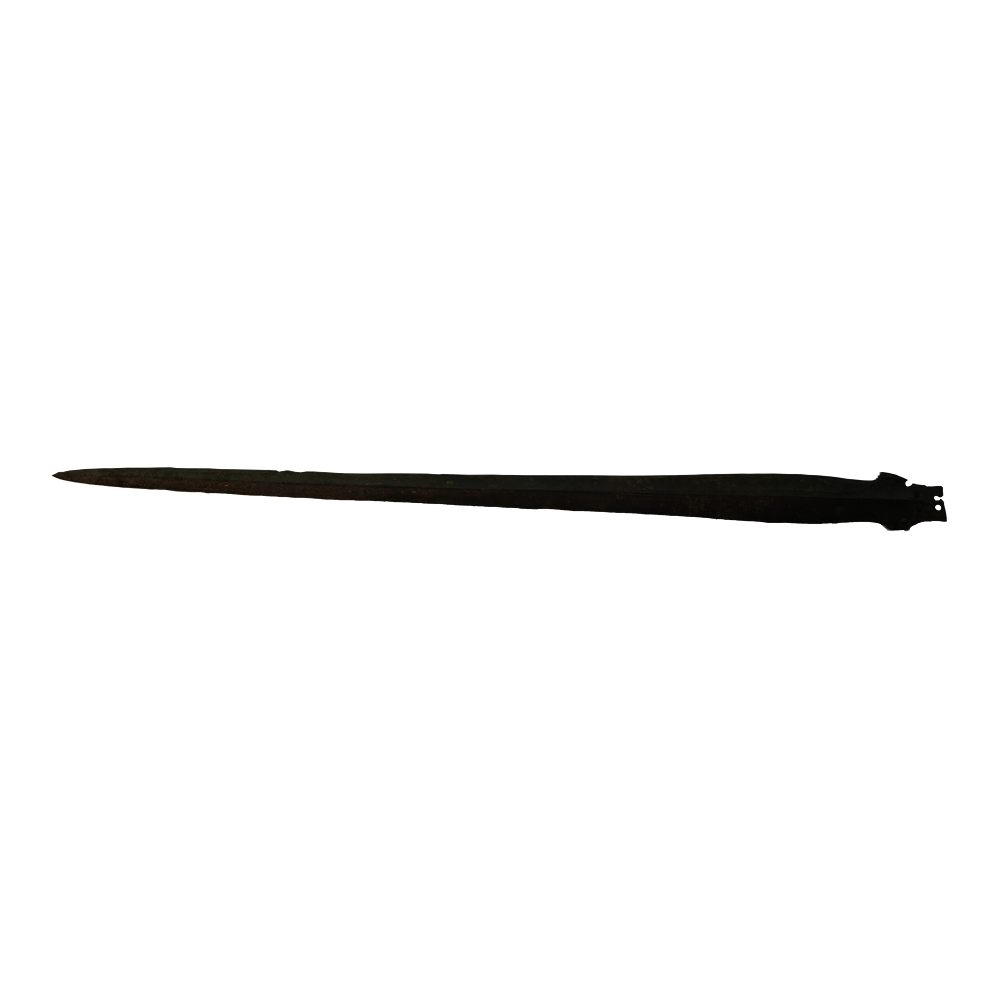
Tongue-hilt sword of the Allerona type. The series of holes visible near the shoulders and on the tang were used to secure the handle.
| Teca |
Display case swords |
|---|---|
| Collocazione | Museum of the Bacchiglione River, Castello di San Martino della Vaneza, Cervarese Santa Croce (Province of Padua), Room XXX, Display case XXX |
| Data | 13th–11th century BC (Final Bronze Age) |
| Materiale | Bronze |
| Misure | Length 61 cm - Width 4,9 cm |
This bronze sword belongs to the Allerona type and can be dated between the 13th and the 11th centuries BCE, during the Final Bronze Age. It comes from the territory of Cervarese Santa Croce and was found along the course of the Bacchiglione River, in the locality of Creola. It is now preserved at the Museo del fiume Bacchiglione, in the Castello di San Martino della Vaneza.
The weapon is characterized by the presence of a grip tongue (lingua da presa), a metal element that formed the structural core of the hilt. The tongue has raised edges with a slightly undulating profile and is pierced by five aligned and regularly spaced holes, intended for the insertion of rivets that secured the handle covering, made of perishable material. The terminal ends of the tongue are oblique, while the upper part has a flat trapezoidal shape.
The shoulders of the blade are long and sloping and connect to the grip tongue through a slight constriction; two holes are present on each side, also functional for fixing the hilt. The blade has a lenticular cross-section and thickens near the shoulders, increasing the solidity of the weapon. The cutting edges, slightly sinuous, are accompanied by two steps that follow their course along the margins, a detail typical of this typology.
From a functional point of view, this is a long slashing weapon, designed for wide and powerful blows. Allerona-type swords are widespread throughout peninsular Italy during the Final Bronze Age, with a particular concentration along the Adriatic side.
The deposition of these weapons is often documented in ritual contexts connected with water, such as rivers and lakes, but the same types also appear as grave goods in warrior burials. This dual context of discovery suggests that the sword was not only a weapon of combat, but also an object charged with symbolic value, linked to status, identity, and ritual practices within Final Bronze Age communities.
Bianchin Citton, E.; Malnati, L. 2001, Protostoric Bronze Finds from the Rivers of the Veneto, in G. Cresci Marrone and M. Tirelli (eds.), Horizons of the Sacred: Cults and Ancient Sanctuaries in Altinum and Eastern Veneto, Proceedings of the Conference (Venice 1999), Rome, pp. 201–202.
Zampieri, G. 1994, Il Museo Archeologico di Padova, Milan, fig. 41b, p. 28.
Padova Preromana 1976, Exhibition Catalogue, Padua, pl. 27, no. 140.
A long slashing weapon, this type is widespread throughout peninsular Italy—particularly along the Adriatic side—during the Final Bronze Age. Its ritual deposition is documented in aquatic contexts, both rivers and lakes, though it also appears among the grave goods of warrior burials.
Cookie policy
Su questo sito utilizziamo strumenti propri o di terze parti che memorizzano piccoli file (cookie) sul tuo dispositivo. I cookie sono normalmente utilizzati per consentire il corretto funzionamento del sito (cookie tecnici), per generare rapporti sull’uso della navigazione (cookie statistici) e per pubblicizzare in modo adeguato i nostri servizi/prodotti (cookie di profilazione). Possiamo utilizzare direttamente i cookie tecnici, ma hai il diritto di scegliere se abilitare o meno i cookie statistici e di profilazione. Abilitando questi cookie, ci aiuti a offrirti un’esperienza migliore.