





N. inventario: IG 77964
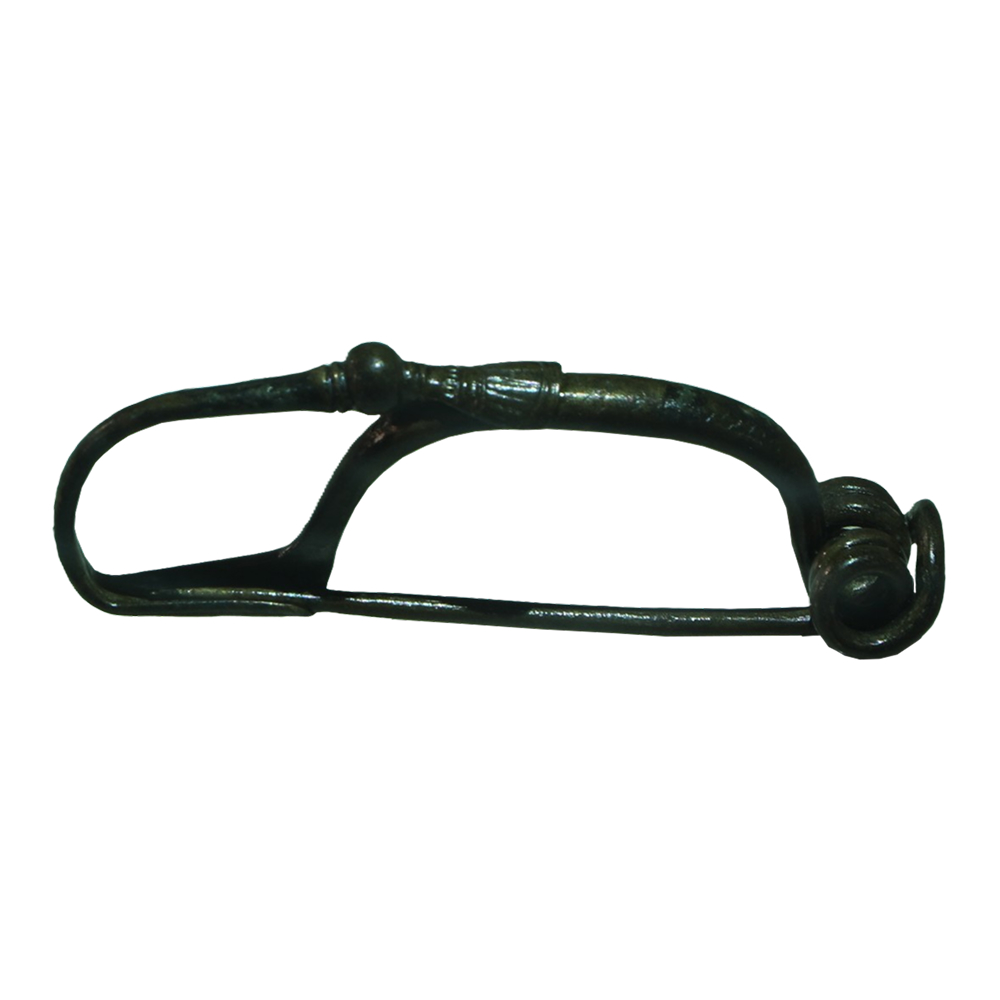
Silver fibula of the Middle La Tène scheme.
| Teca |
Display case ritual sword |
|---|---|
| Collocazione | Museo del Fiume Bacchiglione, Castello di San Martino della Vaneza, Cervarese Santa Croce (Padua), Room XXX, Case XXX |
| Data | First half of the 3rd century BC (Late Iron Age) |
| Materiale | Silver |
| Misure | Length 7,5 cm |
This silver fibula, approximately seven and a half centimeters long, comes from the area of Cervarese Santa Croce and was recovered in 1987 along the Bacchiglione River, in the locality of Tencarola Conche, within the municipality of Selvazzano Dentro. Today it is preserved at the Museo del Fiume Bacchiglione, in the Castello di San Martino della Vaneza, and it is datable to the first half of the 3rd century BCE, during the later phase of the Late Iron Age.
The fibula belongs to the medium La Tène style and can be attributed to the so-called Benacci type, a clearly Celtic typology. It features a symmetrically shaped, elegant and well-proportioned arch, to which a bilateral double-spiral spring with an external wire is attached, a functional element that allowed the fibula to fasten securely onto fabric. The foot of the fibula is folded towards the top of the arch and ends with a decorative appendage characterized by a small globule and a fan-shaped ornament resting on the arch itself, giving the fibula a refined and recognizable appearance.
From a historical and cultural perspective, this object belongs to a well-defined period known as La Tène B2, spanning from the late 4th to the middle of the 3rd century BCE. This phase was marked by tensions between Italic populations and the expanding Gallic tribes throughout the Italian peninsula. Although the Veneto region was not directly affected by armed conflicts, there is clear evidence of the presence and settlement of small Celtic groups, both civilian and military.
These presences are reflected especially in the diffusion of ornamental objects and clothing accessories of Celtic style, such as this silver fibula, as well as in the appearance of weapons and certain elements of local toponymy and onomastics. Similar finds have been documented in several centers of ancient Veneto, including Este, Padua, Altino, Montebello, Gazzo, Adria, and along the Piave Valley.
The fibula was not only a functional item for fastening garments but also a marker of cultural identity and social status. This example thus testifies to the contacts, exchanges, and influences that characterized the Veneto territory during the 3rd century BCE, at a time of profound political and cultural transformation in northern Italy.
Bianchin Citton E., Malnati L. 2001, Reperti bronzei protostorici dai fiumi veneti, in Cresci Marrone G., Tirelli M. (eds.), Orizzonti del sacro. Culto e santuari antichi in Altino e nel Veneto orientale, Proceedings of the Conference (Venice 1999), Rome, pp. 197–223.
The fibula is an object of Celtic taste, produced during the well-defined chronological phase La Tène B2 (325/300–250 BC), when Italic populations were engaged in resisting the expansion of various Gallic tribes across the Italian peninsula.
Although the Veneto region was spared from direct conflict, the movement and settlement of small Celtic groups, both civilian and military, are clearly documented. Evidence of these presences can be observed in the concentration of silver ornaments, clothing accessories, and typically Celtic weapons in several areas, including Este, Padua, Altino, Montebello, Gazzo, Adria, and along the Piave Valley, as well as in toponymy and personal names of Celtic origin.
Cookie policy
Su questo sito utilizziamo strumenti propri o di terze parti che memorizzano piccoli file (cookie) sul tuo dispositivo. I cookie sono normalmente utilizzati per consentire il corretto funzionamento del sito (cookie tecnici), per generare rapporti sull’uso della navigazione (cookie statistici) e per pubblicizzare in modo adeguato i nostri servizi/prodotti (cookie di profilazione). Possiamo utilizzare direttamente i cookie tecnici, ma hai il diritto di scegliere se abilitare o meno i cookie statistici e di profilazione. Abilitando questi cookie, ci aiuti a offrirti un’esperienza migliore.