




N. inventario: IG 148027
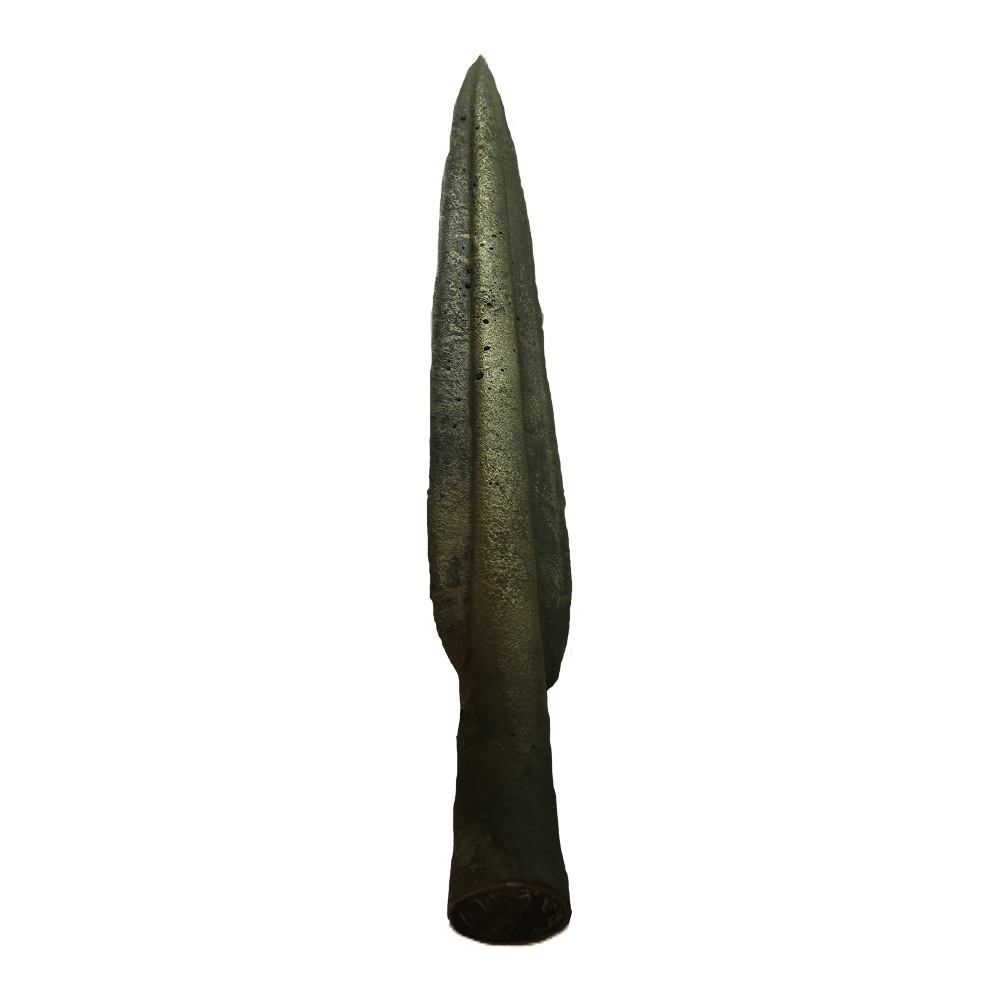
Bronze spearhead with pronounced midrib and socketed haft.
| Teca |
Display case swords |
|---|---|
| Collocazione | Museum of the Bacchiglione River, Castello di San Martino della Vaneza, Cervarese Santa Croce (Province of Padua), Room XXX, Display case XXX |
| Data | 13th–12th century BC (Recent / Late Bronze Age) |
| Materiale | Bronze |
| Misure | Length 26,5 cm - Width 3,9 cm |
This bronze spearhead can be dated between the 13th and the 12th centuries BCE, during the Late Bronze Age. It comes from the territory of Cervarese Santa Croce and was recovered in 1982 from the course of the Bacchiglione River, in the locality of Trambacche. It is now preserved at the Museo del fiume Bacchiglione, in the Castello di San Martino della Vaneza.
The weapon features a socketed hafting system, that is, a hollow part designed to receive the wooden shaft. Just below the junction with the blade, a transverse hole is visible; this was used to firmly secure the spearhead to the shaft by means of a pin or nail. This technical solution ensured the stability of the weapon during use. The blade has an elongated and elegant lanceolate shape and is marked by a very pronounced central rib, with a plano-convex section, which increased both its strength and its penetrating power.
In the equipment of the Late Bronze Age warrior, spears and javelins played a fundamental role, both from a practical point of view and within combat strategies. Spearheads of intermediate size, such as this example measuring about twenty-six centimetres in length, are generally interpreted as belonging to true spears. These weapons were mainly used for thrusting in close combat between infantrymen, often as an alternative to the sword, and therefore had to be heavy enough to ensure an effective impact while still remaining manageable.
Relatively modest dimensions, however, do not entirely rule out the possibility of occasional use as a throwing weapon at short distances. Javelins, by contrast, were usually smaller and lighter and were specifically designed for throwing. This spearhead thus testifies to the versatility of weaponry in the Late Bronze Age and to the importance of hafted weapons in the warfare practices of the period, while also fitting into the broader framework of weapon depositions in fluvial contexts such as that of the Bacchiglione River.
Bianchin Citton, E.; Malnati, L. 2001, Protostoric Bronze Finds from the Rivers of the Veneto, in G. Cresci Marrone and M. Tirelli (eds.), Horizons of the Sacred: Cults and Ancient Sanctuaries in Altinum and Eastern Veneto, Proceedings of the Conference (Venice 1999), Rome, pp. 201–202.
In the armament of the Late Bronze Age warrior, spears and javelins played a crucial role in military equipment and combat tactics.
Points of this size (generally between 22 and 35 cm in length) are usually identified as spearheads, whereas smaller examples are more likely to have armed javelins. The distinction lies primarily in their use during combat: the spear was employed as a thrusting weapon in close engagement between infantrymen, as an alternative to the sword. It needed sufficient weight to deliver impact, yet not so much as to compromise manoeuvrability.
Cookie policy
Su questo sito utilizziamo strumenti propri o di terze parti che memorizzano piccoli file (cookie) sul tuo dispositivo. I cookie sono normalmente utilizzati per consentire il corretto funzionamento del sito (cookie tecnici), per generare rapporti sull’uso della navigazione (cookie statistici) e per pubblicizzare in modo adeguato i nostri servizi/prodotti (cookie di profilazione). Possiamo utilizzare direttamente i cookie tecnici, ma hai il diritto di scegliere se abilitare o meno i cookie statistici e di profilazione. Abilitando questi cookie, ci aiuti a offrirti un’esperienza migliore.