




N. inventario: IG 132630
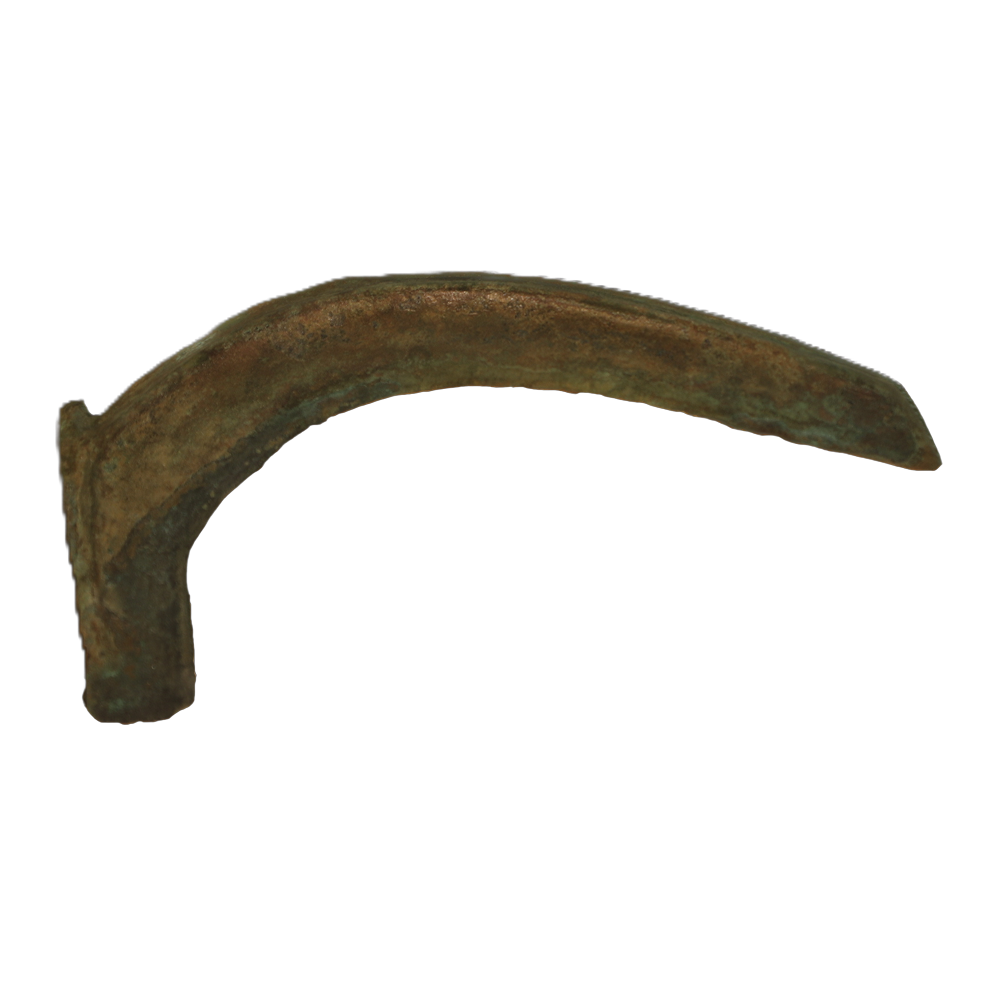
Harvesting sickle with grip-tongue and distinct blade. The tang is set to the left, indicating that the sickle was made for left-handed use.
| Teca |
Display case swords |
|---|---|
| Collocazione | Museum of the Bacchiglione River, Castello di San Martino della Vaneza, Cervarese Santa Croce (Province of Padua), Room XXX, Display case XXX |
| Data | 13th–12th century BC (Recent / Late Bronze Age) |
| Materiale | Bronze |
| Misure | Height 10 cm - Width 16 cm - Diameter 9 cm |
This bronze sickle can be dated between the 13th and the 12th centuries BCE, during the Late Bronze Age. It comes from the territory of Cervarese Santa Croce and was recovered in 1978 by divers from the course of the Bacchiglione River, north-east of Creola. It is now preserved at the Museo del fiume Bacchiglione, in the Castello di San Martino della Vaneza.
It is a harvesting sickle with a grip tongue and a distinct blade, a tool connected with agricultural activities and in particular with reaping. The grip tongue has a rectangular cross-section and shows a slightly raised margin that continues along the back of the blade, turning into a very pronounced rib, intended to reinforce the structure of the implement. In the upper part of the grip there is a clearly defined spur, continuous with the blade attachment, which helped to improve stability and control during use.
A particularly interesting aspect of this object is the position of the tang, placed on the left side with respect to the ribbed face of the blade. This detail clearly indicates that the sickle was designed to be used with the left hand. In bronze sickles, in fact, the rib is present on only one face of the blade, and the orientation of the tool is determined precisely by the position of the tang: on the right in sickles for right-handed users, on the left in those for left-handed users.
The introduction of bronze sickles represents one of the most significant innovations of the Bronze Age, a period marked by major developments in metallurgical techniques. These tools gradually replaced earlier sickles made with flint blades fixed to a wooden support using natural resins.
Left-handed sickles, such as this example from Cervarese, are decidedly rarer than those intended for right-handed use. Among the known parallels are three specimens recovered from the Ljubljanica River in Slovenia, associated with a Sauerbrunn-type sword and dated to the Middle Bronze Age. Further evidence is provided by a casting mould for left-handed sickles discovered in the 1990s at Castellaro del Vhò, in the province of Cremona. This sickle therefore represents a valuable testimony not only to the agricultural practices of the period, but also to the attention paid to functional diversity in tools and to individual needs already in the Bronze Age.
Bianchin Citton, E.; Malnati, L. 2001, Protostoric Bronze Finds from the Rivers of the Veneto, in G. Cresci Marrone and M. Tirelli (eds.), Horizons of the Sacred: Cults and Ancient Sanctuaries in Altinum and Eastern Veneto, Proceedings of the Conference (Venice 1999), Rome, pp. 201–202.
The Bronze Age was par excellence the age of metallurgy. Particularly innovative was the introduction of bronze sickles, which gradually replaced earlier examples made with flint blades inserted into wooden handles and secured with resin.
The blade of this specimen bears a rib on one face only; the orientation of the sickle is therefore determined by the position of the tang to the left or right of the ribbed face. In the Cervarese example, both the ribbing and the left-positioned tang indicate that it was produced for a left-handed user. Left-handed sickles are considerably rarer than right-handed ones. A notable parallel is provided by three specimens recovered from the Ljubljanica River (Slovenia) together with a Sauerbrunn-type sword, dated to the Middle Bronze Age. A casting mould for a left-handed sickle was also discovered in the 1990s at Castellaro del Vhò (Cremona).
Cookie policy
Su questo sito utilizziamo strumenti propri o di terze parti che memorizzano piccoli file (cookie) sul tuo dispositivo. I cookie sono normalmente utilizzati per consentire il corretto funzionamento del sito (cookie tecnici), per generare rapporti sull’uso della navigazione (cookie statistici) e per pubblicizzare in modo adeguato i nostri servizi/prodotti (cookie di profilazione). Possiamo utilizzare direttamente i cookie tecnici, ma hai il diritto di scegliere se abilitare o meno i cookie statistici e di profilazione. Abilitando questi cookie, ci aiuti a offrirti un’esperienza migliore.