




N. inventario: IG 280.812
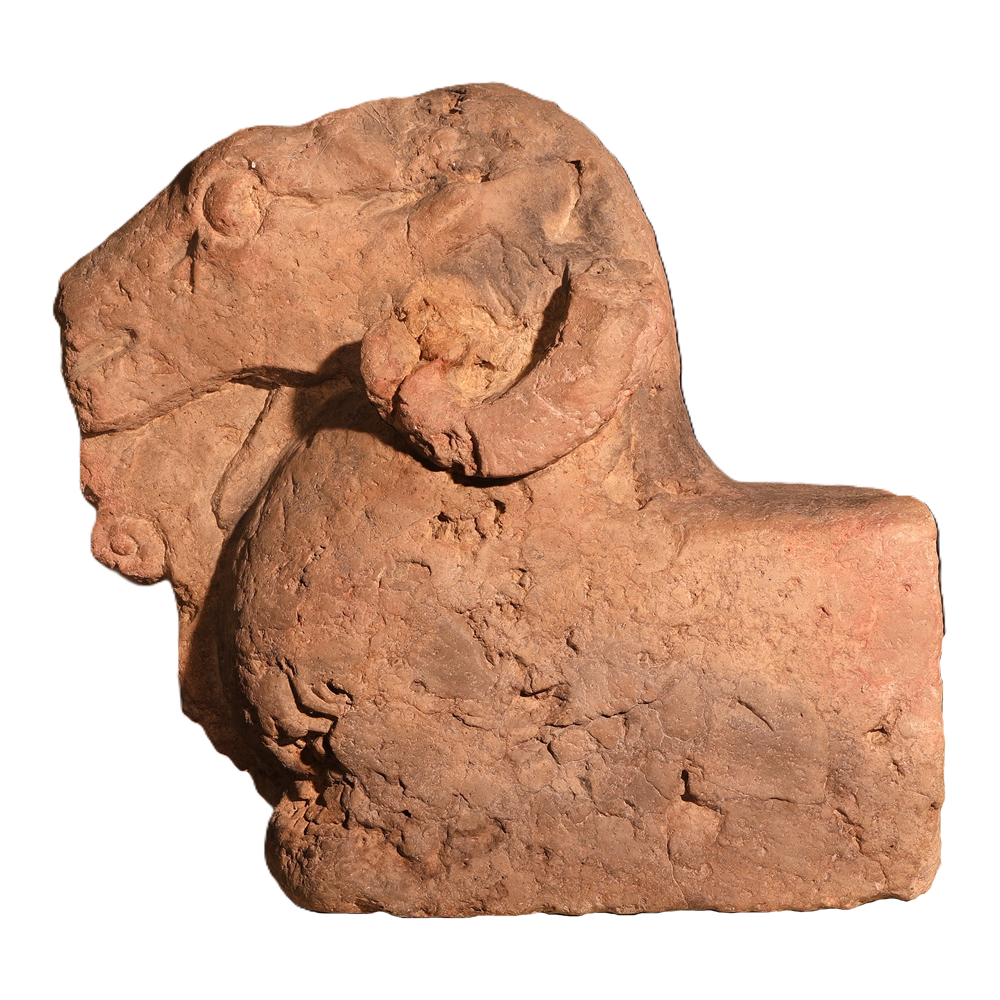
Bench-type andiron in stone with ram’s-head terminal.
| Teca |
Display case andiron |
|---|---|
| Collocazione | Museum of the Bacchiglione River, Castello di San Martino della Vaneza, Cervarese Santa Croce (Province of Padua), Room XXX, Display case XXX |
| Data | 6th–5th century BC (Iron Age) |
| Materiale | Euganean trachyte from Monte Cero |
| Misure | Height 47 cm - Width 50 cm |
This bench-type alare in stone, datable to between the 6th and 5th centuries BCE (Iron Age), comes from Cervarese Santa Croce, along the course of the Bacchiglione River near the Castle of San Martino, and is currently preserved at the Museo del Fiume Bacchiglione in the Castello di San Martino della Vaneza. Made from Euganean trachyte from Monte Cero, it measures 47 cm in height and 50 cm in width.
It is a large bench-type alare, with a squared parallelepiped base, characterized by an end sculpted as a ram’s head. The animal’s snout is supported by a double curl motif positioned in front of the prominent chest; the mouth is represented by a deep horizontal incision, while the eyes consist of two circular grooves with a protruding bulge. On top of the head rise two large curled horns, giving the object a solemn and symbolic appearance.
Alari were domestic objects used to contain embers from the hearth and to support spits and logs for burning. While they were primarily made of terracotta and, more rarely, of stone or metal, all known stone alari in the Veneto region feature the typical ram’s head. This animal, symbolizing the “leader” of the flock, represented strength and fertility, conferring protective and regenerative qualities to the household.
The Cervarese alare, due to its material, large size, and attention to detail, suggests that it may have been intended not only for domestic use but also for a votive context, where its presence would have carried symbolic and protective significance.
Bianchin Citton, E.; Malnati, L. 2001, Protostoric Bronze Finds from the Rivers of the Veneto, in G. Cresci Marrone and M. Tirelli (eds.), Horizons of the Sacred: Cults and Ancient Sanctuaries in Altinum and Eastern Veneto, Proceedings of the Conference (Venice 1999), Rome, p. 207, fig. 11.
Bianchin Citton, E. 1996, Alare a protome d’ariete, in Restituzioni ’96, Cittadella (Padua), pp. 22–25.
Andirons were domestic implements designed to contain the embers of the hearth and to support spits and fire-dogs used for cooking. They were made primarily of terracotta and, more rarely, of stone or metal. All known stone andirons from Veneto terminate in a ram’s head.
As the “leader” of the flock, the ram symbolised strength and fertility and likely conveyed ideas of regeneration and household protection. The Cervarese example—by virtue of its material, large size, and the care devoted to its workmanship and detailing—may be more appropriately associated with a votive context rather than a purely domestic one.
Cookie policy
Su questo sito utilizziamo strumenti propri o di terze parti che memorizzano piccoli file (cookie) sul tuo dispositivo. I cookie sono normalmente utilizzati per consentire il corretto funzionamento del sito (cookie tecnici), per generare rapporti sull’uso della navigazione (cookie statistici) e per pubblicizzare in modo adeguato i nostri servizi/prodotti (cookie di profilazione). Possiamo utilizzare direttamente i cookie tecnici, ma hai il diritto di scegliere se abilitare o meno i cookie statistici e di profilazione. Abilitando questi cookie, ci aiuti a offrirti un’esperienza migliore.