




N. inventario: IG 280816
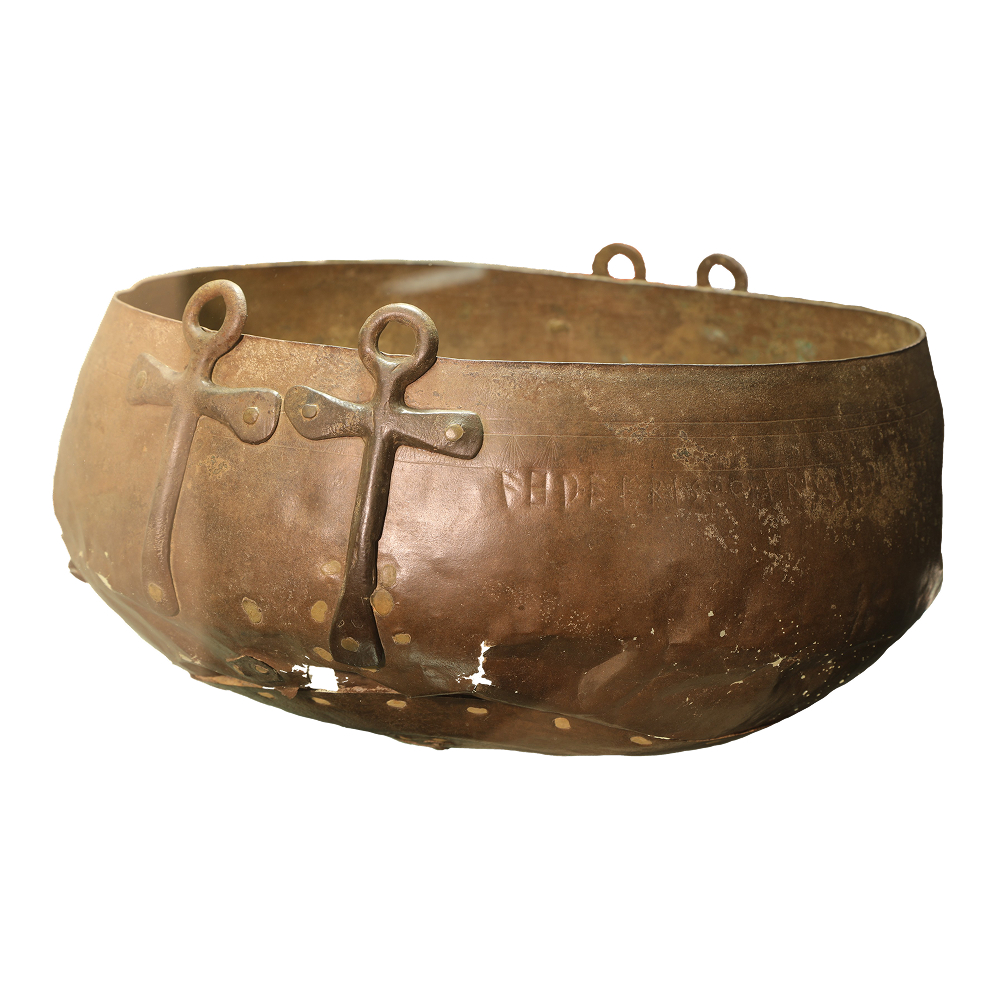
Bronze lebes with cross-shaped fittings, decorated below the rim with engraved geometric linear motifs. An inscription runs along the outer wall of the vessel, just beneath the decorative band.
| Teca |
Display case metal vessels |
|---|---|
| Collocazione | Museo del Fiume Bacchiglione, Cervarese Santa Croce (Padua), Room XXX, Case XXX |
| Data | Lebes: 6th century BC; inscription: 5th century BC (Iron Age) |
| Materiale | Bronze sheet |
| Misure | Height 16 cm - Diameter 29,5 cm |
The artifact is a lebete made from a bronze sheet, equipped with cross-shaped fittings for attaching a double handle. It is decorated beneath the rim with linear geometric motifs engraved with a burin. On the exterior wall, immediately below the decorated band, runs an inscription along the circumference of the vessel, making this object unique and exceptional within the context of pre-Roman Veneto.
The lebete is preserved at the Museo del Fiume Bacchiglione in Cervarese Santa Croce. The vessel itself can be dated to the 6th century BC, while the inscription, created at a later stage, dates to the 5th century BC, during the height of the Iron Age. The artifact was recovered from the Bacchiglione River and measures 16 cm in height with a diameter of 29.5 cm.
Morphologically, the vessel has two cross-shaped fittings per side, intended for securing a mobile double handle. The engraved geometric decoration below the rim, combined with the inscription, gives the object particular historical and cultural significance.
The inscription, engraved in a rightward direction.
The text allows for multiple interpretations, depending on the proposed function of the vessel. Funerary or votive purposes seem less likely, whereas it is more plausible that the inscription refers to a gift. The term ekupetabos, related to the root ekupeta- (also found in ekupetaris), appears connected to the equestrian domain and the figure of the cavalryman (eques). The main interpretations proposed are:
An object referring to the social rank of the equites (cavalrymen);
A person (possibly an official) associated with the equites;
A prize awarded in a horse race;
A person (possibly an official) involved in organizing equestrian competitions.
In pre-Roman Veneto, the lebete was a luxury item reserved for members of the aristocratic elite, used during prestigious banquets. It is likely that such vessels also circulated as gifts within networks of elite relationships. After extended domestic use, lebete could be deposited in tombs to serve as ossuaries. The earliest examples are documented in Padua, in the so-called “tomb of the embossed vessels,” dated between the late 8th and early 7th centuries BC. Later, the type spread primarily along the Piave Valley and in alpine areas, reaching the Slovene-Istrian region.
Venetkens 2013, Lebete con iscrizione, cat. 10.2.1, in Venetkens. Viaggio nella terra dei Veneti antichi, Exhibition catalogue (Padua, Palazzo della Ragione, 2013).
Marinetti A. 2004, Iscrizione venetica su lebete bronzeo da Cervarese S. Croce (Padova), in Studi Etruschi LXX (2005), pp. 363–368.
Bianchin Citton E., Malnati L. 2001, Reperti bronzei protostorici dai fiumi veneti, in Cresci Marrone G., Tirelli M. (eds.), Orizzonti del sacro. Culto e santuari antichi in Altino e nel Veneto orientale, Proceedings of the Conference (Venice 1999), Rome, p. 208, fig. 12.
Locatelli D. 2002, Bronzi votivi e pubblici, in Akeo. I tempi della scrittura, Exhibition catalogue (Montebelluna–Cornuda 2002), Cornuda (TV), pp. 111–119.
In pre-Roman Veneto, the lebes was a luxury object reserved for members of the aristocratic elite and used during prestigious banquets. These vessels likely also circulated as prestige gifts exchanged within elite networks.
After a long period of domestic use, lebete could sometimes be deposited in burials as ossuary containers. The earliest examples are documented in Padua, in the so-called “tomb of the embossed vessels”, dated between the late 8th and early 7th centuries BC.
From there the type spread widely, with significant concentrations along the Piave Valley and in Alpine areas, extending as far as the Slovene-Istrian region.
Cookie policy
Su questo sito utilizziamo strumenti propri o di terze parti che memorizzano piccoli file (cookie) sul tuo dispositivo. I cookie sono normalmente utilizzati per consentire il corretto funzionamento del sito (cookie tecnici), per generare rapporti sull’uso della navigazione (cookie statistici) e per pubblicizzare in modo adeguato i nostri servizi/prodotti (cookie di profilazione). Possiamo utilizzare direttamente i cookie tecnici, ma hai il diritto di scegliere se abilitare o meno i cookie statistici e di profilazione. Abilitando questi cookie, ci aiuti a offrirti un’esperienza migliore.