





N. inventario: IG 148026
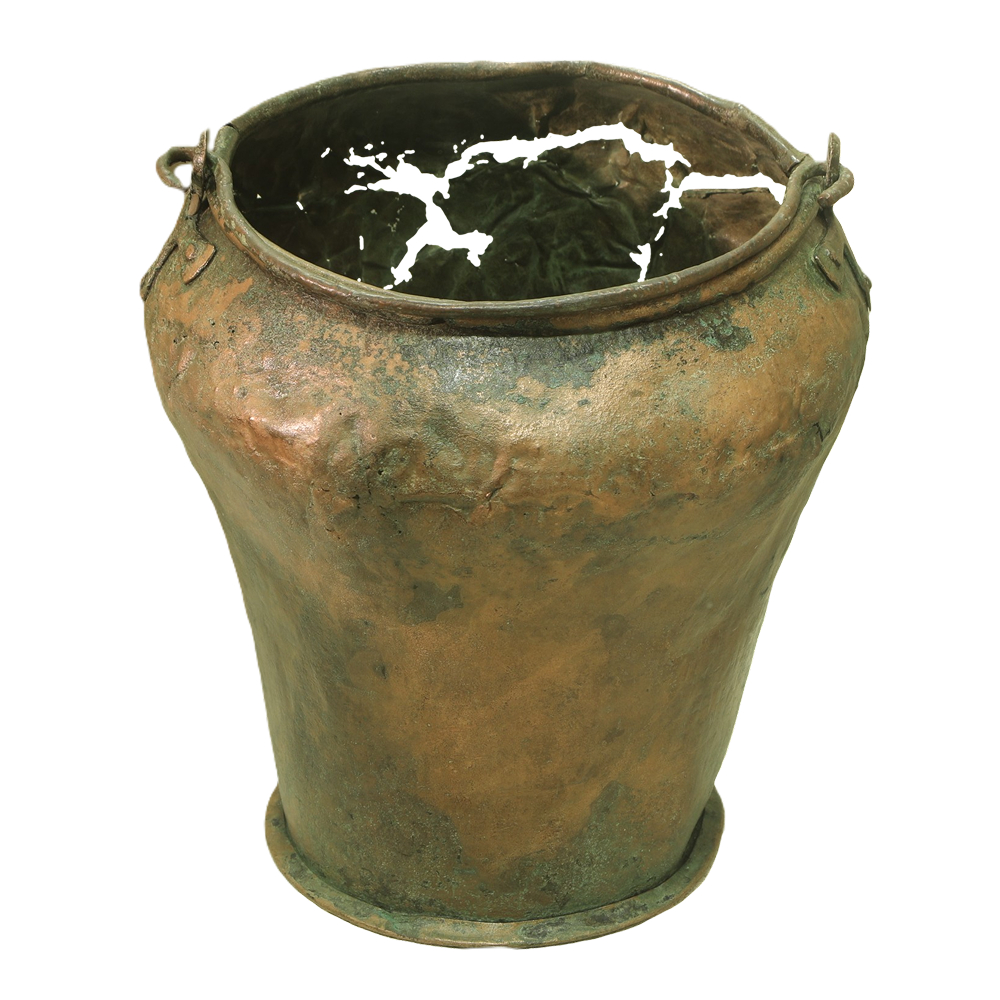
Bronze situla with sloping shoulder and sinuous body, with handle attached by cross-shaped fittings.
| Teca |
Display case metal vessels |
|---|---|
| Collocazione | Museo del Fiume Bacchiglione, Castello di San Martino della Vaneza, Cervarese Santa Croce (Padua), Room XXX, Case XXX |
| Data | 4th–3rd century BC (Late Iron Age) |
| Materiale | Bronze |
| Misure | Height 18,5 cm - Diameter 14,5 cm |
This bronze situla can be dated between the 4th and the 3rd centuries BCE, during the Late Iron Age. It comes from the territory of Cervarese Santa Croce and was recovered along the course of the Bacchiglione River, downstream from the bridge of Trambacche, in the municipality of Veggiano, between the 1970s and 1980s. It is now preserved at the Museo del fiume Bacchiglione, in the Castello di San Martino della Vaneza.
The vessel features a sloping shoulder and a body with a sinuous profile, made from a single sheet of bronze and closed along the side with five rivets. The rim was formed by folding the sheet outward around a lead rod, a technical solution that provided greater strength and a refined finish to the edge. The flat base consists of a bronze disk with its margins folded outward and inserted into the lower part of the body, ensuring the stability of the container.
The situla is equipped with a movable handle of circular section, with folded ends, attached to the body by two distinctive cross-shaped fittings. These elements did not serve only a structural purpose, but also played a decorative and symbolic role: in their stylised form it is possible to recognise an allusion to the human figure, reduced to essential signs.
From a comparative perspective, this situla finds a particularly significant parallel in the famous princely tomb of Nerka at Este, which belonged to a high-ranking woman and is precisely dated between 250 and 225 BCE thanks to the presence of imported pottery. In that context, the situla formed part of a rich assemblage that included a banquet set, tools for spinning and weaving, toiletry objects, and numerous items of jewellery, all indicating a high social status.
Another important comparison is offered by the well-known inscribed situla from Cembra, in Trentino, as well as by a few other examples characterised by a high shoulder and cross-shaped attachments. These vessels are distributed along routes linking the Venetian foothill area with Austria and Slovenia, passing through the Cadore region. The same type of attachment is also found on other forms of bronze vessels, such as lebetes, whose distribution follows similar paths. This example from the Bacchiglione thus testifies to the existence of wide-ranging exchange networks and cultural contacts, while also reflecting the symbolic and social value attributed to bronze objects in the Late Iron Age.
Bianchin Citton E., Malnati L. 2001, Reperti bronzei protostorici dai fiumi veneti, in Cresci Marrone G., Tirelli M. (eds.), Orizzonti del sacro. Culto e santuari antichi in Altino e nel Veneto orientale, Proceedings of the Conference (Venice 1999), Rome, p. 207, fig. 10d.
The situla finds a close comparison in the princely tomb of Nerka at Este, belonging to an aristocratic woman and precisely dated between 250 and 225 BC thanks to imported pottery. The grave assemblage also included a rich banquet service, a spinning and weaving set, toiletry objects, and numerous items of jewellery, indicating the high social status of the deceased.
Another comparison is represented by the famous inscribed situla from Cembra (Trentino) and by a small number of other situlae characterised by high shoulders and cross-shaped attachments, distributed along routes linking the Venetian foothills with Austria and Slovenia through the Cadore region. This type of attachment, which presents a stylised representation of the human figure, is also found on other types of bronze vessels such as lebetes (an example is the inscribed lebes also recovered from the Bacchiglione River), whose distribution follows similar routes.
Cookie policy
Su questo sito utilizziamo strumenti propri o di terze parti che memorizzano piccoli file (cookie) sul tuo dispositivo. I cookie sono normalmente utilizzati per consentire il corretto funzionamento del sito (cookie tecnici), per generare rapporti sull’uso della navigazione (cookie statistici) e per pubblicizzare in modo adeguato i nostri servizi/prodotti (cookie di profilazione). Possiamo utilizzare direttamente i cookie tecnici, ma hai il diritto di scegliere se abilitare o meno i cookie statistici e di profilazione. Abilitando questi cookie, ci aiuti a offrirti un’esperienza migliore.