





N. inventario: IG 71394
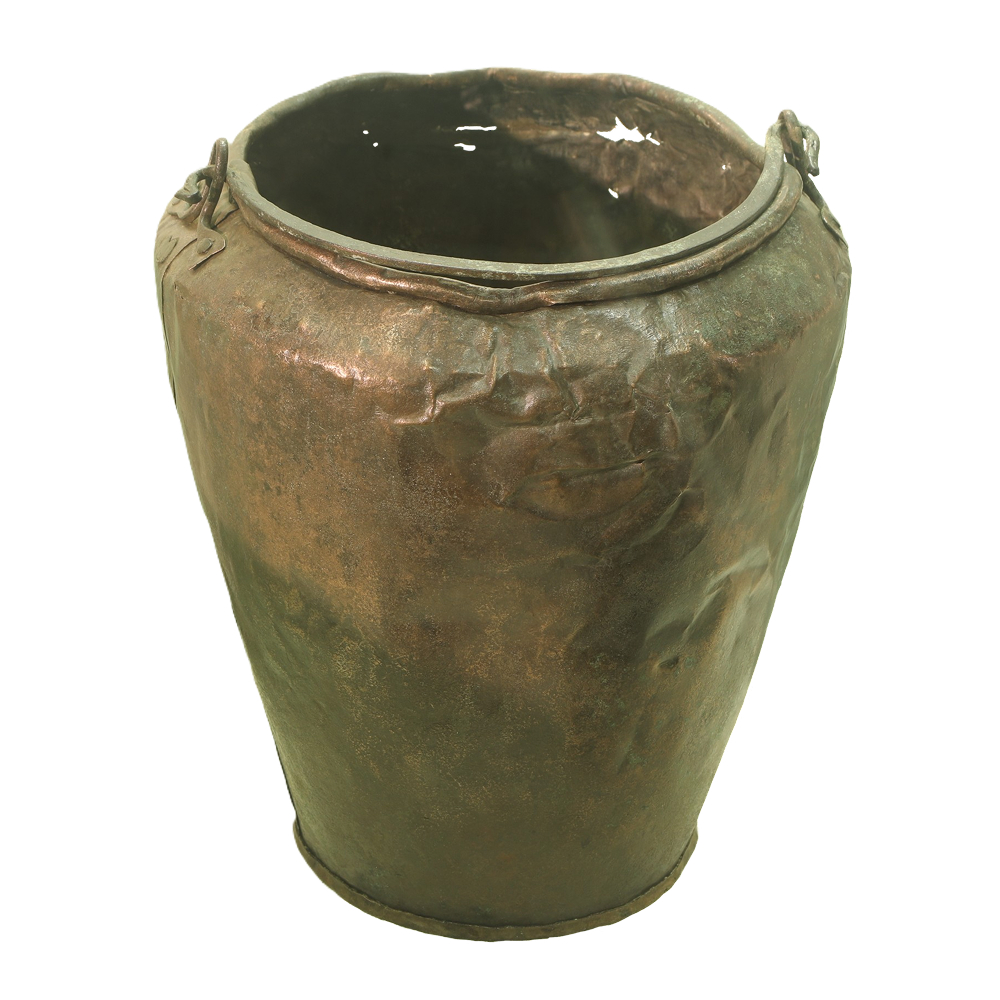
Bronze ovoid situla with handle and short plate-shaped attachments.
| Teca |
Display case metal vessels |
|---|---|
| Collocazione | Museo del Fiume Bacchiglione, Castello di San Martino della Vaneza, Cervarese Santa Croce (Padua), Room XXX, Case XXX |
| Data | Late 7th–6th century BC (Early Iron Age) |
| Materiale | Bronze |
| Misure | Height 22 cm - Diameter 13 cm |
This bronze situla, characterized by its ovoid shape, dates to the late 7th–6th century BC, during the Early Iron Age. It comes from the area of Cervarese Santa Croce and was recovered from the course of the Bacchiglione River, along the stretch between Cervarese and Padua, in the 1970s and 1980s. It is now housed in the Museo del Fiume Bacchiglione, in the Castello di San Martino della Vaneza.
The vessel was made from a single sheet of bronze, closed along the side by seven rivets. The rim was formed by rolling the sheet around a lead rod, a technical solution that reinforced the edge and improved its finish. The shoulder is rounded, the body has a truncated conical profile, and the slightly concave base consists of a bronze disc folded outward over the lower edge of the body.
The situla is fitted with a movable handle of rectangular section, with folded ends terminating in small stylized duck protomes, a decorative motif with strong symbolic significance. The handle is attached to the body by means of two loops ending in short plate-shaped terminals, each fixed with two rivets, a system that combines functionality with careful ornamental detail.
Situlae are metal vessels, most commonly made of bronze, with a bucket-like shape, and they were luxury items among the ancient Veneti communities. They were used during banquets to contain and serve alcoholic beverages, such as wine, often mixed with water and spices according to Mediterranean-derived customs. The possession of bronze tableware and the adoption of practices such as the symposium were privileges of the aristocracy, who used these objects to display their wealth and reinforce their social status.
These vessels could remain in use for several generations and, once their domestic function had come to an end, were often reused as ossuary containers in burials. More rarely, situlae also appear in votive contexts: in such cases, their deposition is likely connected with ritual consumption and the offering of alcoholic beverages to the deities, within the framework of ceremonies or sacred banquets.
Bianchin Citton E., Malnati L. 2001, Reperti bronzei protostorici dai fiumi veneti, in Cresci Marrone G., Tirelli M. (eds.), Orizzonti del sacro. Culto e santuari antichi in Altino e nel Veneto orientale, Proceedings of the Conference (Venice 1999), Rome, p. 207, fig. 10d.
Situlae are metal vessels (most frequently made of bronze) with a bucket-like shape, luxury objects used by the ancient Veneti to contain and serve alcoholic beverages such as wine, often mixed with water and spices during banquets. The possession of bronze tableware and the adoption of customs such as the symposium were privileges of the aristocracy, who displayed their wealth and reinforced their social prestige through such practices.
Used for several generations, once their domestic function ended these vessels were often reused as ossuary containers in burials. Their occurrence, although rare, in votive contexts may be linked to the ritual consumption and offering of alcoholic beverages to the deities, probably within the framework of sacred banquets.
Cookie policy
Su questo sito utilizziamo strumenti propri o di terze parti che memorizzano piccoli file (cookie) sul tuo dispositivo. I cookie sono normalmente utilizzati per consentire il corretto funzionamento del sito (cookie tecnici), per generare rapporti sull’uso della navigazione (cookie statistici) e per pubblicizzare in modo adeguato i nostri servizi/prodotti (cookie di profilazione). Possiamo utilizzare direttamente i cookie tecnici, ma hai il diritto di scegliere se abilitare o meno i cookie statistici e di profilazione. Abilitando questi cookie, ci aiuti a offrirti un’esperienza migliore.