





N. inventario: IG 74896
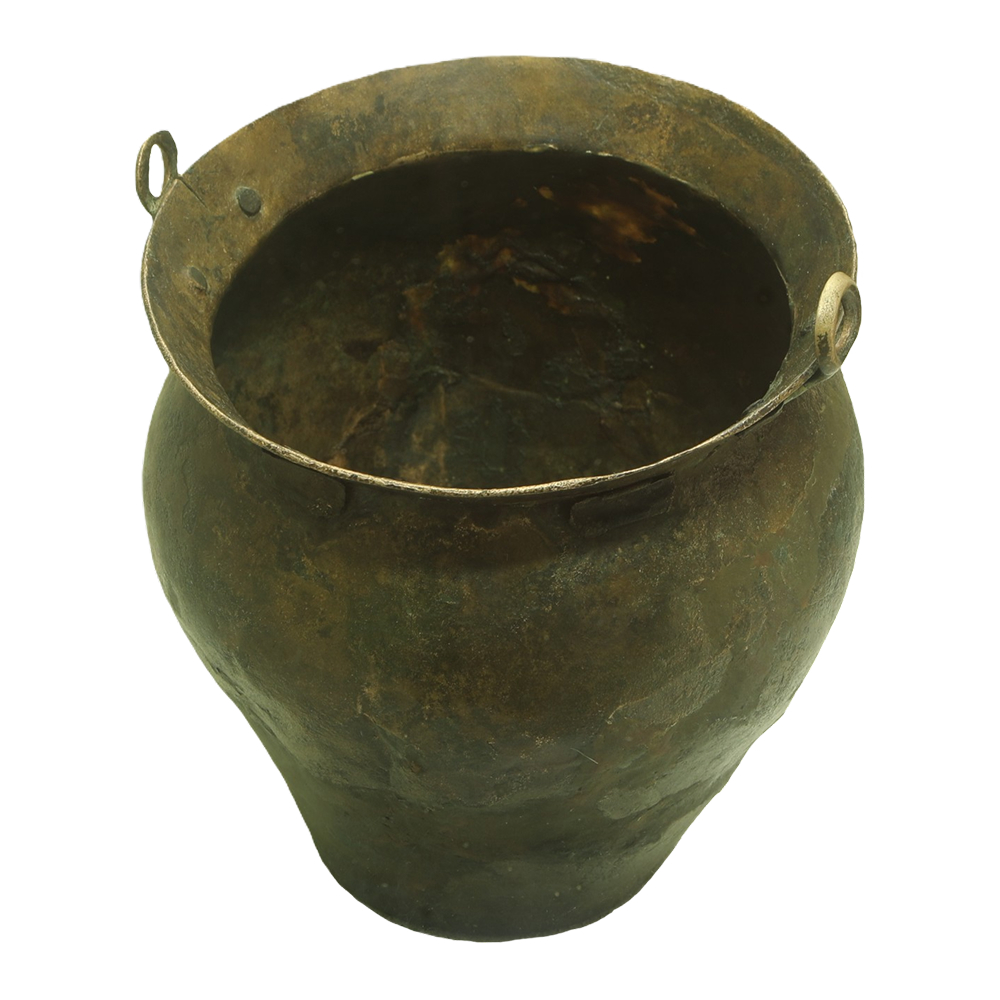
Small ovoid situla with funnel-shaped rim, lacking its handle.
| Teca |
Display case metal vessels |
|---|---|
| Collocazione | Museo del Fiume Bacchiglione, Castello di San Martino della Vaneza, Cervarese Santa Croce (Padua), Room XXX, Case XXX |
| Data | 2nd–1st century BC (period of Romanization) |
| Materiale | Bronze |
| Misure | Height 14 cm - Diameter 12 cm |
This small bronze situla dates to the 2nd–1st century BC, during the period of Romanization. It comes from the area of Cervarese Santa Croce and was recovered between 1977 and 1978 from the course of the Bacchiglione River, in the locality of Creola, within the municipality of Saccolongo. It is now preserved in the Museo del Fiume Bacchiglione, in the Castle of San Martino della Vaneza.
The vessel is of small size and is characterized by an ovoid shape and a funnel-shaped rim. The handle is not preserved, but two circular loop attachments are still visible along the rim, ending in rectangular expansions fixed to the body by rivets. The shoulder is sloping, while the body has a smoothly rounded profile; the flat base ensured stability for the container.
In the Veneto region, this example finds close parallels with a situla recovered from the bed of the Brenta River, likewise lacking handle attachments and handle, as well as with other situlae deposited in Gallic burials in the Verona area, dating to the 1st century BC. These comparisons help to frame the object chronologically and culturally, placing it within a transitional phase between local Iron Age traditions and the new models introduced during the Roman period.
The discovery of this small situla forms part of a broader pattern of activity along the Bacchiglione River, from which situlae of different periods and types have been recovered. These finds range from the Late Bronze Age, represented by Kurd-type situlae, through the Iron Age, with ovoid situlae and the famous inscribed lebes, to the threshold of the Roman period, exemplified by this piece. It is likely that these vessels were also involved in water-related cult practices, either because of their contents—such as alcoholic beverages offered in ritual contexts—or because of the symbolic and material value of the bronze itself.
The presence of numerous archaeological finds recovered between Cervarese Santa Croce, Trambacche, and Creola confirms continuous human activity along the banks of the Bacchiglione from at least the Late Bronze Age onward, highlighting the central role of the river as a place of settlement, movement, and ritual over the centuries.
Bianchin Citton E., Malnati L. 2001, Reperti bronzei protostorici dai fiumi veneti, in Cresci Marrone G., Tirelli M. (eds.), Orizzonti del sacro. Culto e santuari antichi in Altino e nel Veneto orientale, Proceedings of the Conference (Venice 1999), Rome, p. 207, fig. 10d.
Within the Veneto region, the small situla from the Bacchiglione finds a close comparison with a specimen recovered from the Brenta River, lacking both handle attachments and handle, and with other situlae deposited in Gallic burials in the Verona area, dated to the 1st century BC.
Several situlae of different types and periods have been recovered from the bed of the Bacchiglione River. These range from the Late Bronze Age (Kurd-type situlae) through the Iron Age (ovoid situlae and the inscribed lebes) to the threshold of the Roman period, represented by the present example.
It is likely that these artefacts were also used in ritual practices connected with water, possibly because of their contents—such as alcoholic beverages like wine—or because of their intrinsic material value. Continuous human presence along the riverbanks of the Bacchiglione since at least the Late Bronze Age is confirmed by the recovery of numerous archaeological materials in the areas of Cervarese Santa Croce, Trambacche, and Creola.
Cookie policy
Su questo sito utilizziamo strumenti propri o di terze parti che memorizzano piccoli file (cookie) sul tuo dispositivo. I cookie sono normalmente utilizzati per consentire il corretto funzionamento del sito (cookie tecnici), per generare rapporti sull’uso della navigazione (cookie statistici) e per pubblicizzare in modo adeguato i nostri servizi/prodotti (cookie di profilazione). Possiamo utilizzare direttamente i cookie tecnici, ma hai il diritto di scegliere se abilitare o meno i cookie statistici e di profilazione. Abilitando questi cookie, ci aiuti a offrirti un’esperienza migliore.