



N. inventario: IG 168523
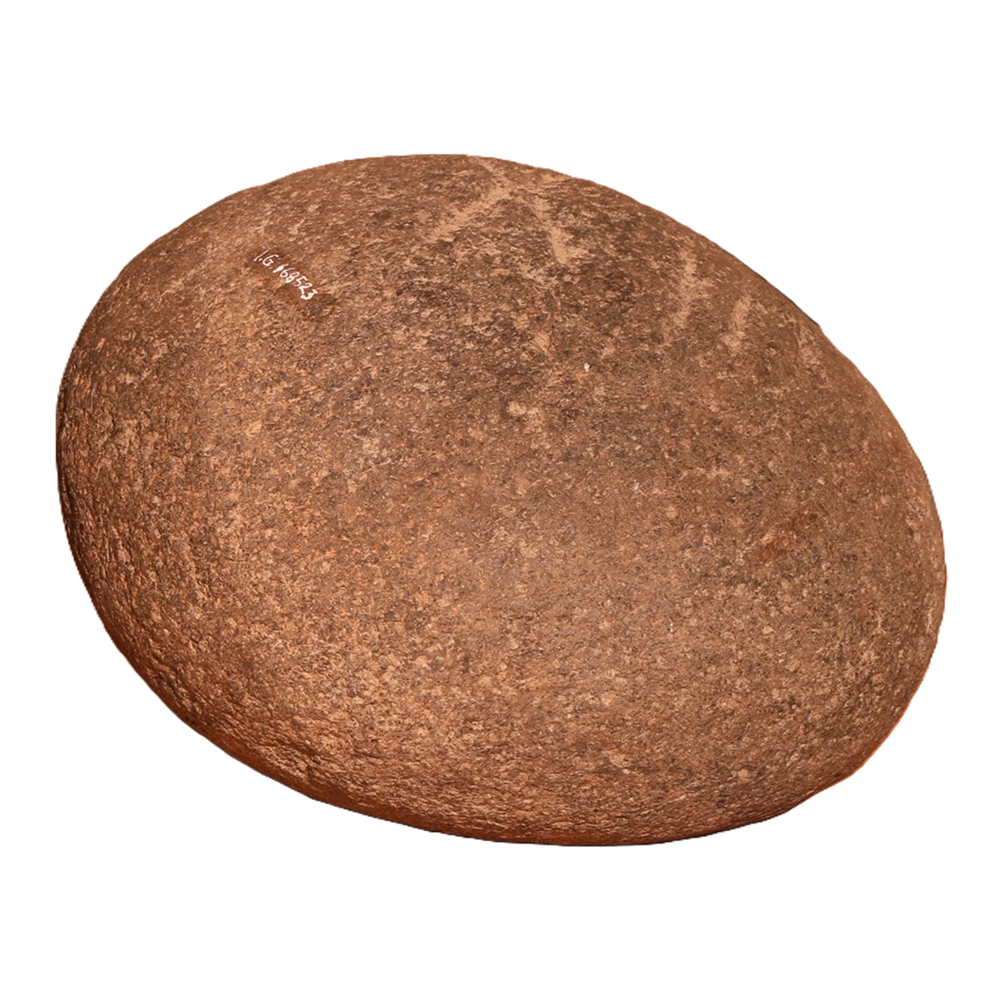
Ovoid porphyry pebble with incised marks “XIII”.
| Teca |
Display case pebbles |
|---|---|
| Collocazione | Museum of the Bacchiglione River, Castello di San Martino della Vaneza, Cervarese Santa Croce (Province of Padua), Room XXX, Display case XXX |
| Data | 5th–4th century BC (Second Iron Age) |
| Materiale | Porphyry |
| Misure | Height 11,5 cm - Width 11,3 cm - Length 16 cm |
The artifact is an ovoid porphyry pebble with a slightly flattened shape, preserved at the Museo del Fiume Bacchiglione in the Castello di San Martino della Vaneza in Cervarese Santa Croce. It can be dated to between the 5th and 4th centuries BC, during the Second Iron Age, and comes from the Bacchiglione River at Bassanello, where it was recovered in 1983 by Mr. Pezzato. Its dimensions are 11.5 cm in height, 11.3 cm in width, and 16 cm in length.
On the surface of the pebble are four inscribed marks arranged in sequence, readable as XIII. The three I characters gradually decrease in height from left to right, a detail that appears intentional rather than accidental.
Inscribed pebbles constitute a well-attested class of objects in Padua and its surrounding territory from the 5th century BC onward. The diversity of recovery contexts—including urban and extra-urban domestic areas as well as funerary sites—together with the nature of the inscriptions, has led scholars to interpret these objects as possible cenotaphs or markers “in memory of” someone. Inscriptions are mostly personal names, while abbreviated forms with only a few letters or symbolic signs are rarer.
The pebble under study, being relatively smaller than typical inscribed pebbles, is more difficult to classify within this group. The absence of precise stratigraphic context or defined archaeological setting complicates a definitive functional interpretation of the incised marks. Nevertheless, it cannot be excluded that the object may have served a practical purpose, such as a boundary marker, a sign indicating a road distance, or more generally a territorial or administrative marker, analogous to numerous other markers—inscribed or uninscribed—found in marginal and peripheral areas of ancient Padua.
Bianchin Citton, E.; Malnati, L. 2001, Protostoric Bronze Finds from the Rivers of the Veneto, in G. Cresci Marrone and M. Tirelli (eds.), Horizons of the Sacred: Cults and Ancient Sanctuaries in Altinum and Eastern Veneto, Proceedings of the Conference (Venice 1999), Rome, p. 207.
Inscribed pebbles form a well-attested class of objects in Padua and its territory from the 5th century BC onwards. The heterogeneity of their find contexts—ranging from domestic, urban, and extra-urban settlements to funerary settings—together with the character of the inscriptions, has led scholars to interpret them as cenotaphs or memorial markers (“in memory of”).
The inscriptions generally consist of personal names, and more rarely of short sequences of letters. The present pebble is somewhat smaller than average and can only tentatively be included within this latter group. Unfortunately, the lack of precise information regarding its discovery and stratigraphic context makes it more difficult to propose a definite function or to interpret the incised signs.
It cannot be excluded that the object served to mark a boundary, indicate a road distance, or function more generally as a territorial or administrative marker—similar to the numerous boundary stones, inscribed or uninscribed, found in marginal and surrounding areas of ancient Padua.
Cookie policy
Su questo sito utilizziamo strumenti propri o di terze parti che memorizzano piccoli file (cookie) sul tuo dispositivo. I cookie sono normalmente utilizzati per consentire il corretto funzionamento del sito (cookie tecnici), per generare rapporti sull’uso della navigazione (cookie statistici) e per pubblicizzare in modo adeguato i nostri servizi/prodotti (cookie di profilazione). Possiamo utilizzare direttamente i cookie tecnici, ma hai il diritto di scegliere se abilitare o meno i cookie statistici e di profilazione. Abilitando questi cookie, ci aiuti a offrirti un’esperienza migliore.