





N. inventario: IG 33101
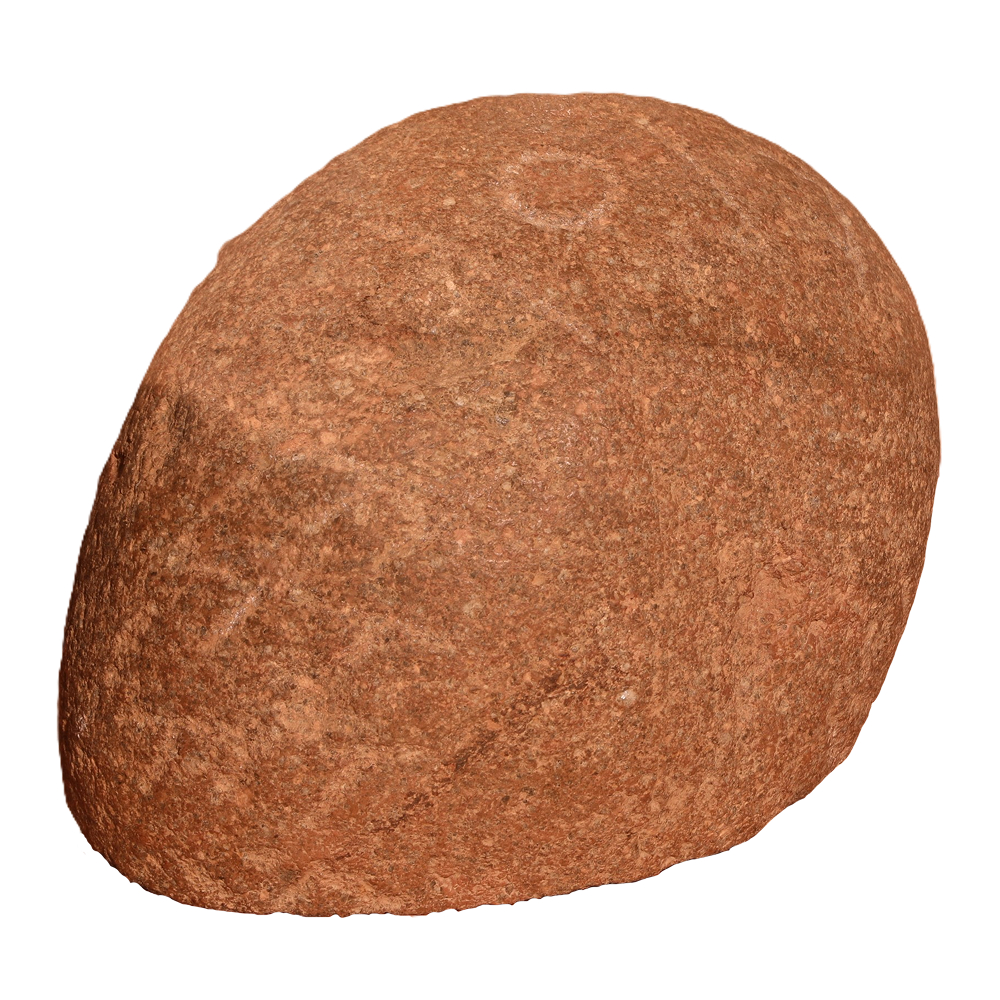
Mutilated inscribed pebble in red porphyry.
| Teca |
Display case pebbles |
|---|---|
| Collocazione | Museum of the Bacchiglione River, Castello di San Martino della Vaneza, Cervarese Santa Croce (Province of Padua), Room XXX, Display case XXX |
| Data | 5th–4th century BC (Second Iron Age) |
| Materiale | Red porphyry |
| Misure | Height 18 cm - Width 21 cm - Length 26 cm |
The artifact is a red porphyry cobble with a slightly flattened oval shape, now mutilated, preserved at the Museo del Fiume Bacchiglione, in the Castello di San Martino della Vaneza in Cervarese Santa Croce. It can be dated to between the 5th and 4th centuries BC, during the Second Iron Age, and comes from the Bacchiglione River near Cervarese, where it was recovered in 1975. The preserved dimensions are 18 cm in height, 21 cm in width, and 26 cm in length.
On the cobble’s surface is an inscription arranged in a loosely spiral pattern, running from the maximum circumference toward the center. Due to a fracture in the support, the text is incomplete and only partially legible:
.e.nokleve.s. [———(-)] ni.s.
Enokleves [ ] nis
The epigraphic formula can be interpreted as a compound personal name (binomial formula), in which -nis functions appositively in relation to Enokleves. The presence of the Venetic name Enokleves is particularly significant from a linguistic and cultural perspective, as it reflects a shared Indo-European heritage: the element -kleves is linked to the concept of “glory,” widely attested in the formation of Indo-European compound names.
Of particular interest is the comparison with an inscribed cobble recovered almost simultaneously at Costabissara (VI). That artifact features an inscription linguistically attributable to the Vicenza area, yet engraved on a support – the cobble – that is typically Patavian. This association confirms the cultural influence exerted by Padua over the Vicenza territory in the pre-Roman period, likely facilitated by the existence of a communication route connecting the two centers already in ancient times.
Marinetti, A. 2013, Aklon: Names on Stone, in Venetkens. Journey into the World of the Ancient Veneti, Exhibition Catalogue (Padua 2013), pp. 250–251.
Marinetti, A.; Prosdocimi, A.L. 2005, Language and Writing, in De Min, M.; Gamba, M.; Gambacurta, G.; Ruta Serafini, A. (eds.), The Invisible City. Pre-Roman Padua. Thirty Years of Excavations and Research, Ozzano Emilia (Bologna), pp. 37–38, inscription no. 23, p. 44.
Fogolari, G.; Prosdocimi, A.L. 1988, I Veneti antichi, Padua, pp. 289–290.
Padova Preromana 1976, Exhibition Catalogue (Padua 1976), Padua, pp. 49–50, 307, no. 83.
Prosdocimi, A.L.; Mancini, A. 1975, Venetico VII–VIII, in Archivio Veneto CV, Pa 23.
The almost contemporaneous discovery of an inscribed pebble at Costabissara (province of Vicenza) has prompted important geographical and cultural considerations. That specimen bears a short inscription which, from a linguistic perspective, is fully Vicentine; yet it is engraved on a type of support—the large pebble—that is typically associated with Padua.
This circumstance confirms the cultural influence radiating from Padua towards Vicenza, likely facilitated by the existence of a communication route linking the two centres in the pre-Roman period.
Cookie policy
Su questo sito utilizziamo strumenti propri o di terze parti che memorizzano piccoli file (cookie) sul tuo dispositivo. I cookie sono normalmente utilizzati per consentire il corretto funzionamento del sito (cookie tecnici), per generare rapporti sull’uso della navigazione (cookie statistici) e per pubblicizzare in modo adeguato i nostri servizi/prodotti (cookie di profilazione). Possiamo utilizzare direttamente i cookie tecnici, ma hai il diritto di scegliere se abilitare o meno i cookie statistici e di profilazione. Abilitando questi cookie, ci aiuti a offrirti un’esperienza migliore.