





N. inventario: IG 71445
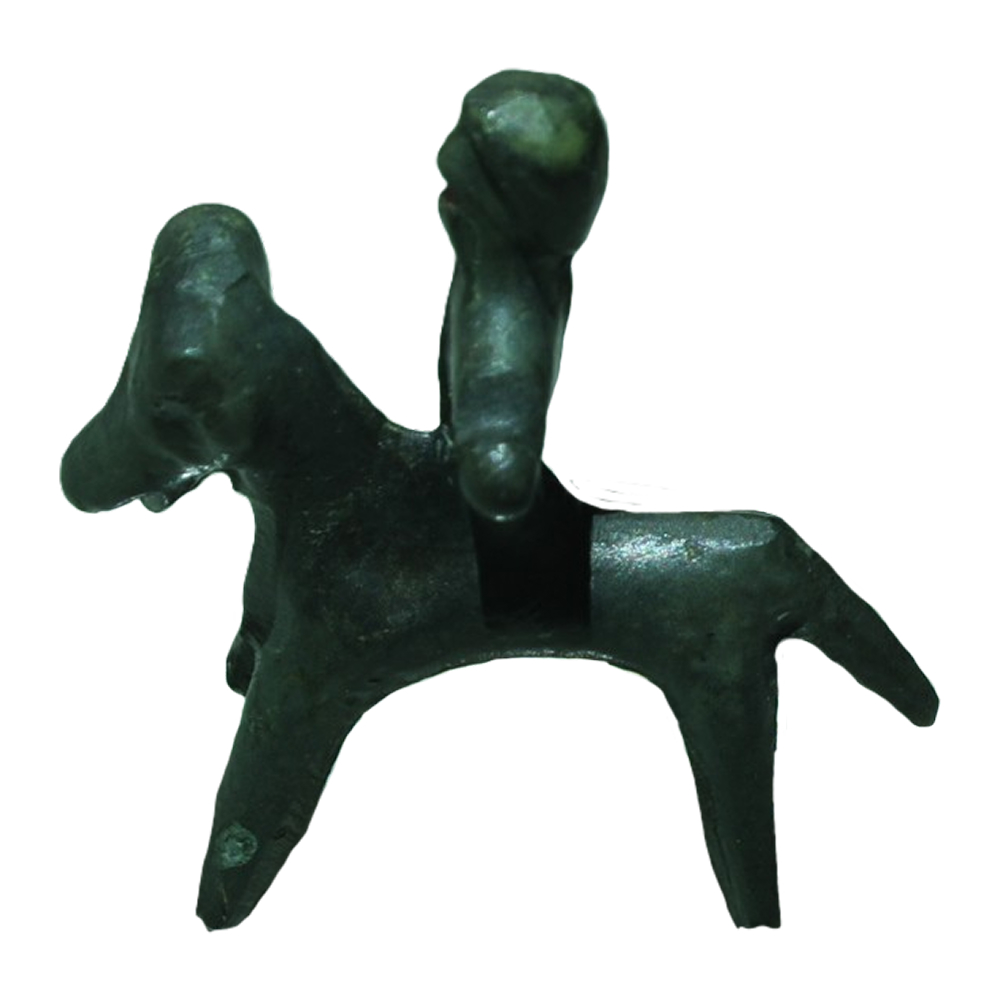
Schematic votive bronze statuette of a mounted warrior.
| Teca |
Display case ritual sword |
|---|---|
| Collocazione | Museo del Fiume Bacchiglione, Castello di San Martino della Vaneza, Cervarese Santa Croce (Padua), Room XXX, Case XXX |
| Data | 5th–4th century BC (Late Iron Age) |
| Materiale | Bronze |
| Misure | Height 4,2 cm |
This small votive bronze figurine depicts a warrior on horseback and is datable to between the 5th and 4th centuries BCE, during the Late Iron Age. It comes from the area of Cervarese Santa Croce and was recovered sporadically along the Bacchiglione River, in the stretch between Cervarese and Padua, during the 1970s and 1980s. Today it is preserved at the Museo del Fiume Bacchiglione, in the Castello di San Martino della Vaneza.
The statuette, just over four centimeters tall, is rendered in a strongly schematic and stylized manner. The warrior is shown seated on the horse, with the right arm shaped in a loop for holding a spear, while the left arm, shaped like a fin and pierced, was intended to hold a shield. The head is elongated, with hollowed eyes, a pronounced nose, and the mouth indicated by a simple horizontal groove; a headdress or helmet is visible on the head. The rider’s legs are only suggested, almost merging with the body of the animal.
The horse is also represented in an essential, simplified form: the legs are tubular and rigid, as is the long tail; the neck is extended forward, while the ears are suggested by two concavities. The mouth and nostrils are indicated by fine incisions, enough to make the animal recognizable.
This bronze figurine is part of a broader production of votive objects distributed throughout the Padua area, which included not only mounted warriors, but also foot soldiers, isolated horses, devotees, and small reproductions of human anatomical parts. These artifacts were produced by local workshops, characterized by a rigid and simplified style and rather basic workmanship, indicative of serial production for ritual use rather than refined artistic intent.
Originally, these warrior figurines, whether on foot or mounted, were meant to be completed with actual armament, at least a spear and a shield. These elements, made separately and inserted into the holes in the arms, are now almost always lost. Nevertheless, the figurine retains a strong symbolic value: through the offering of the cavalry figure, the devotee entrusted their identity, social role, or a request for protection to the deity, often in ritual contexts associated with water and rivers such as the Bacchiglione.
Bianchin Citton E., Malnati L. 2001, Reperti bronzei protostorici dai fiumi veneti, in Cresci Marrone G., Tirelli M. (eds.), Orizzonti del sacro. Culto e santuari antichi in Altino e nel Veneto orientale, Proceedings of the Conference (Venice 1999), Rome, pp. 201, 206, fig. 10a.
This small bronze figurine belongs to a votive production widely attested in the territory of ancient Padua. Besides mounted warriors, this category also includes devotees, standing warriors, horses, and anatomical votive offerings.
The generally rigid and schematic style, together with the coarse and simplified workmanship, suggests a local workshop production of modest quality.
Figurines representing warriors, whether mounted or on foot, were originally equipped with weapons, most likely spear and shield. These elements are almost never preserved, as they were probably made separately and inserted into the holes provided in one or both arms of the statuette.entrambe le braccia.
Cookie policy
Su questo sito utilizziamo strumenti propri o di terze parti che memorizzano piccoli file (cookie) sul tuo dispositivo. I cookie sono normalmente utilizzati per consentire il corretto funzionamento del sito (cookie tecnici), per generare rapporti sull’uso della navigazione (cookie statistici) e per pubblicizzare in modo adeguato i nostri servizi/prodotti (cookie di profilazione). Possiamo utilizzare direttamente i cookie tecnici, ma hai il diritto di scegliere se abilitare o meno i cookie statistici e di profilazione. Abilitando questi cookie, ci aiuti a offrirti un’esperienza migliore.