




N. inventario: IG 103266
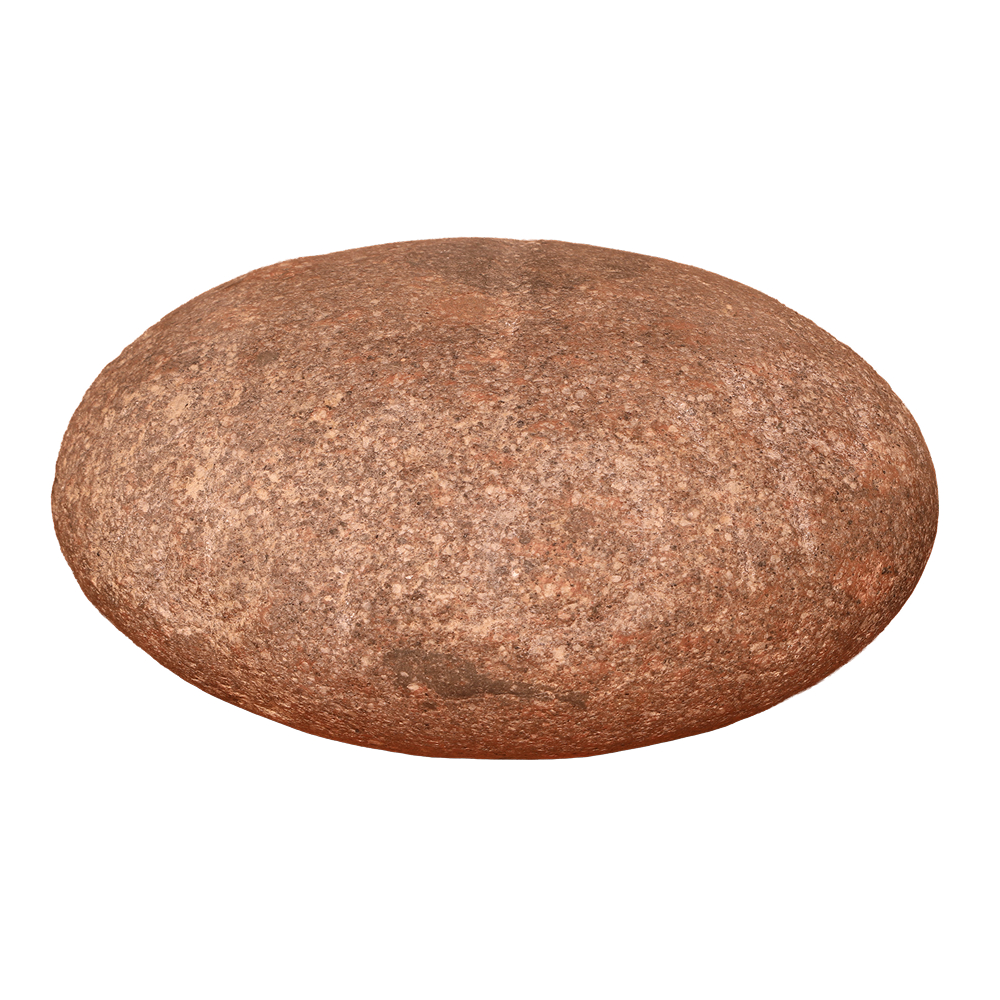
Large porphyry pebble with poorly legible inscription containing an onomastic formula.
| Teca |
Display case pebbles |
|---|---|
| Collocazione | Museum of the Bacchiglione River, Castello di San Martino della Vaneza, Cervarese Santa Croce (Province of Padua), Room XXX, Display case XXX |
| Data | 5th–4th century BC (Second Iron Age) |
| Materiale | Porphyry |
| Misure | Height 25 cm - Width 15,5 cm - Length 30 cm |
The artifact is a large porphyry cobble with a slightly flattened oval shape, bearing an inscription that is now difficult to read. It is preserved at the Museo del Fiume Bacchiglione, in the Castello di San Martino della Vaneza in Cervarese Santa Croce. The object can be dated to between the 5th and 4th centuries BC, during the Second Iron Age, and was recovered from the Bacchiglione River, in the Trambacche area (Veggiano), by the Padua Scuba Diving Club in 1979. Its dimensions are 25 cm in height, 15.5 cm in width, and 30 cm in length.
The inscription runs along the cobble’s maximum expansion for about 80 cm; however, due to erosion that occurred in antiquity, many letters are now difficult to discern. The legible sequence is fragmentary:
(?)a.me.i.e.—sfnoiio.i(.
Despite its state of preservation, it is possible to recognize a male binomial name in the dative case; however, the gaps in the text do not allow for a more precise reading or interpretation of its content.
From a technical point of view, the cobble has a rather coarse crystalline texture, which negatively affected the quality of the engraving. The poor legibility of the letters can be explained by two main hypotheses: on one hand, the lithological nature of the porphyry, with large crystals, would have made it difficult to execute the strokes, causing irregular chipping; on the other hand, the inscription may have been executed poorly and subsequently rejected, without refinement or retracing of the letters, and ultimately intentionally erased through hammering.
This artifact fits within the broader context of inscribed cobbles from the Veneto area, generally interpreted as markers or memorial monuments, often associated with riverine contexts and ritual or commemorative practices, although in this case the state of the inscription does not allow the original function to be determined with certainty.
Bianchin Citton, E.; Malnati, L. 2001, Protostoric Bronze Finds from the Rivers of the Veneto, in G. Cresci Marrone and M. Tirelli (eds.), Horizons of the Sacred: Cults and Ancient Sanctuaries in Altinum and Eastern Veneto, Proceedings of the Conference (Venice 1999), Rome, p. 207.
Prosdocimi, A.L. 1984, Venetic: Two New Paduan Pebbles. Morphology and Onomastic System, New Data, in Studi Etruschi, vol. L, part II, pp. 199–204, Pa 27.
The pebble is characterised by a coarse grain with rather large crystals, and the incision on its surface is extremely poor, to the extent that the individual letters can no longer be clearly identified. This condition may be explained in two ways:
Cookie policy
Su questo sito utilizziamo strumenti propri o di terze parti che memorizzano piccoli file (cookie) sul tuo dispositivo. I cookie sono normalmente utilizzati per consentire il corretto funzionamento del sito (cookie tecnici), per generare rapporti sull’uso della navigazione (cookie statistici) e per pubblicizzare in modo adeguato i nostri servizi/prodotti (cookie di profilazione). Possiamo utilizzare direttamente i cookie tecnici, ma hai il diritto di scegliere se abilitare o meno i cookie statistici e di profilazione. Abilitando questi cookie, ci aiuti a offrirti un’esperienza migliore.