




N. inventario: IG 71313
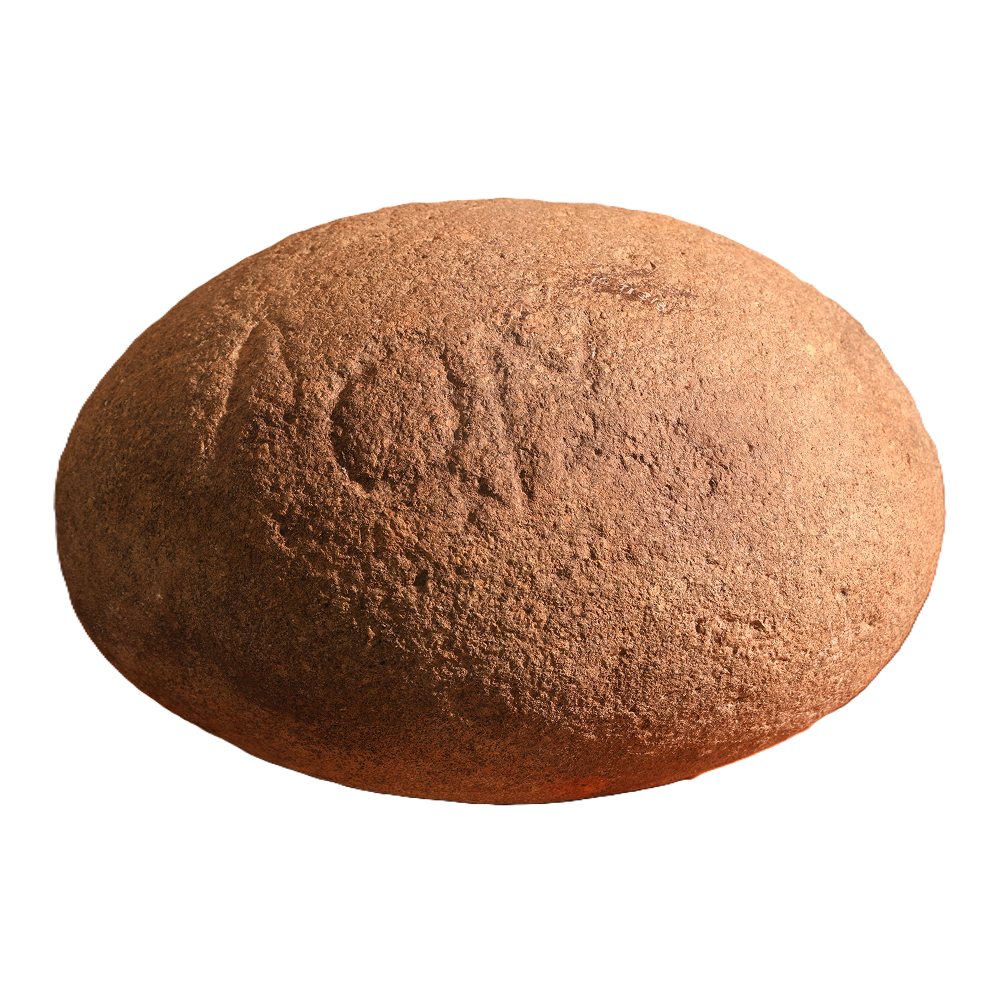
Large porphyry pebble with incised inscription.
| Teca |
Display case pebbles |
|---|---|
| Collocazione | Museum of the Bacchiglione River, Castello di San Martino della Vaneza, Cervarese Santa Croce (Province of Padua), Room XXX, Display case XXX |
| Data | 4th century BC (Second Iron Age) |
| Materiale | Porphyry |
| Misure | Height 20,5 cm - Width 22,9 cm - Length 29,5 cm |
The artifact is a large porphyry cobble with a slightly flattened oval shape, engraved with an inscription running along its maximum circumference. It is preserved at the Museo del Fiume Bacchiglione, in the Castello di San Martino della Vaneza in Cervarese Santa Croce. The object can be dated to the 4th century BC, during the Second Iron Age, and was recovered from the Bacchiglione River by the Padua Scuba Diving Club in the 1970s. Its dimensions are considerable: 20.5 cm in height, 22.9 cm in width, and 29.5 cm in length.
The inscription, written in a rightward direction, reads:
la.n.te.i. aklo.n.
Lantei aklon
“Aklon for Lante”
The term Lantei is an individual name in the dative case, referring to a person, while aklon designates the object itself and can be translated as “marker” or “signpost.” Therefore, the expression can be interpreted as “the marker of Lante.” If the cobble had been found in a funerary context, it would likely have indicated the burial place of Lante; however, its extra-urban location and recovery from a river setting suggest a cenotaph function instead—that is, a symbolic monument erected in memory of a person without the presence of the body.
This cobble belongs to a well-attested category of inscribed objects in the Veneto region, with about twenty examples known solely in Padua, coming from both funerary and habitation contexts, as well as sporadic finds. At least four of these feature the formula aklon, whose root ak- (“point,” “summit”) evokes the idea of an emerging element, a marker, or a signpost.
This meaning, combined with finds from inhabited areas (such as via Piazze in the center of Padua) and along the Bacchiglione River, has led scholars to interpret such objects as cenotaphs, i.e., “monuments in memory of” someone.
The connection with the funerary sphere thus remains open, although more in an evocative sense than strictly as grave markers. Moreover, the riverine context of recovery, together with the cobble’s ovoid shape—a symbol traditionally associated with the origin of the cosmos—suggests the possibility of ritual practices linked to initiatory forms of cult, perhaps of a mystery nature, similar to evidence attested in Magna Graecia and Italic regions.
Marinetti, A. 2013, Aklon: Names on Stone, in Venetkens. Journey into the World of the Ancient Veneti, Exhibition Catalogue (Padua 2013), pp. 250–251.
Marinetti, A.; Prosdocimi, A.L. 2005, Language and Writing, in De Min, M.; Gamba, M.; Gambacurta, G.; Ruta Serafini, A. (eds.), The Invisible City. Pre-Roman Padua. Thirty Years of Excavations and Research, Ozzano Emilia (Bologna), pp. 37–38, fig. 36, inscription no. 37, pp. 45–46.
Bianchin Citton, E.; Malnati, L. 2001, Protostoric Bronze Finds from the Rivers of the Veneto, in G. Cresci Marrone and M. Tirelli (eds.), Horizons of the Sacred: Cults and Ancient Sanctuaries in Altinum and Eastern Veneto, Proceedings of the Conference (Venice 1999), Rome, p. 207.
Marinetti, A.; Prosdocimi, A.L. 1994, New Inscribed Venetic Pebbles from Palaeo-Venetic Padua, in Studi di Archeologia della X Regio in ricordo di Michele Tombolani, Rome, pp. 171–194, figs. 2–3, Pa 33.
This pebble belongs to a category of variably inscribed stones which, in Padua alone, number around twenty examples. They have been recovered from funerary contexts, settlement areas, and occasional stray finds. At least four bear the incised formula aklon, whose root ak- (“point, summit”) denotes something projecting or emerging—thus a marker or indicator.
This meaning, combined with find contexts within settlement areas (such as Via Piazze in central Padua) and near the Bacchiglione River (as in the present case), has led scholars to interpret these objects as cenotaphs—“monuments in memory of.” The connection with the funerary sphere therefore remains open, albeit in an evocative sense.
River finds, however—also considering the egg-like shape of these stones, a symbolic image of cosmic origin—open further possibilities. They may reflect ritual acts connected with initiation into otherwise unknown cult practices, perhaps of a mystery character, comparable to those documented in the Italic and Magna Graecia cultural spheres.
Cookie policy
Su questo sito utilizziamo strumenti propri o di terze parti che memorizzano piccoli file (cookie) sul tuo dispositivo. I cookie sono normalmente utilizzati per consentire il corretto funzionamento del sito (cookie tecnici), per generare rapporti sull’uso della navigazione (cookie statistici) e per pubblicizzare in modo adeguato i nostri servizi/prodotti (cookie di profilazione). Possiamo utilizzare direttamente i cookie tecnici, ma hai il diritto di scegliere se abilitare o meno i cookie statistici e di profilazione. Abilitando questi cookie, ci aiuti a offrirti un’esperienza migliore.