




N. inventario: IG 77963
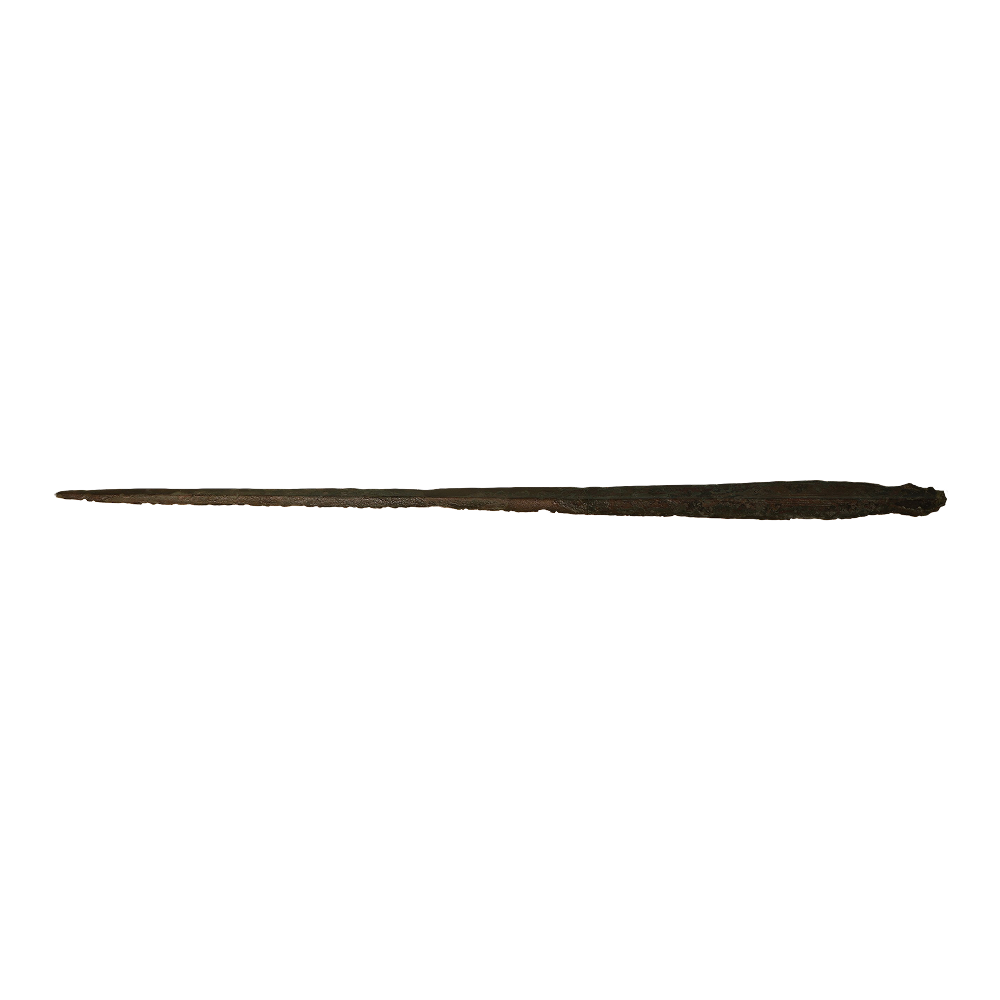
Sauerbrunn-type sword with simple tang, broken near the base. The blade is decorated with two symmetrical groups of ribs that converge into the central midrib.
| Teca |
Display case swords |
|---|---|
| Collocazione | Museum of the Bacchiglione River, Castello di San Martino della Vaneza, Cervarese Santa Croce (Province of Padua), Room XXX, Display case XXX |
| Data | 16th–15th century BC (Middle Bronze Age) |
| Materiale | Bronze |
| Misure | Length 55 cm - Width 4,9 cm |
This bronze sword belongs to the Sauerbrunn type and can be dated to between the 16th and 15th centuries BCE, during the height of the Middle Bronze Age. It comes from the territory of Cervarese Santa Croce and was recovered in 1988 along the course of the Bacchiglione River. It is now preserved at the Museo del fiume Bacchiglione, in the Castello di San Martino della Vaneza.
The weapon is missing its base, namely the part that originally connected the blade to the hilt, which was made of organic material. This missing area was most likely decorated with the typical motif of two inward-rolled volutes, characteristic of swords of this type and often interpreted as a symbolic representation of eyes. Despite the break, the blade is largely preserved and measures approximately fifty-five centimeters in length.
The blade is characterized by a strongly pronounced central ridge with a triangular cross-section, which ensured solidity and resistance. On either side of this ridge runs a refined decoration engraved with a burin: two symmetrical groups, each composed of three parallel lines that progressively converge until they meet along the central ridge. Along the edges of the blade, thin cracks are also visible, probably caused both by use and by processes of deposition and long-term preservation.
Swords of the Sauerbrunn type, sometimes also referred to as Sauerbrunn–Boiu, are considered particularly significant finds for understanding long-distance relationships active during the Bronze Age. Their distribution covers a very wide geographical area, ranging from the Po Plain and northeastern Italy to Central and Eastern Europe, including regions such as Austria, Slovenia, and Croatia, extending north as far as Germany and Poland, and eastward to Slovakia, Hungary, and Romania.
These weapons occur both in funerary contexts, deposited in the graves of Bronze Age warriors—as in the case of Olmo di Nogara—and in votive riverine and lacustrine contexts. In the latter cases, swords were offered to the waters as ritual gifts, probably connected to religious and symbolic beliefs. This specimen as well, found along the Bacchiglione, testifies to the central role of waterways as places of worship and offering, as well as routes of communication and exchange in the Bronze Age world.
Bianchin Citton, E.; Malnati, L. 2001, Protostoric Bronze Finds from the Rivers of the Veneto, in G. Cresci Marrone and M. Tirelli (eds.), Horizons of the Sacred: Cults and Ancient Sanctuaries in Altinum and Eastern Veneto, Proceedings of the Conference (Venice 1999), Rome, pp. 201–202.
Sauerbrunn–Boiu type swords constitute a particularly diagnostic category of bronze artefacts for tracing long-distance connections between western Veneto and central-eastern Europe, established during the early phases of the Bronze Age and becoming even more evident in the Middle Bronze Age. These swords are distributed across a vast geographical area, extending from the Po Plain and north-eastern Italy northwards to Germany and Poland, and eastwards to Slovakia, Hungary, and Romania, including Austria, Slovenia, and Croatia.
They occur both in riverine and lacustrine votive contexts—offered as gifts to the waters—and in funerary settings, deposited in the graves of Bronze Age warriors (for example at Olmo di Nogara).
Cookie policy
Su questo sito utilizziamo strumenti propri o di terze parti che memorizzano piccoli file (cookie) sul tuo dispositivo. I cookie sono normalmente utilizzati per consentire il corretto funzionamento del sito (cookie tecnici), per generare rapporti sull’uso della navigazione (cookie statistici) e per pubblicizzare in modo adeguato i nostri servizi/prodotti (cookie di profilazione). Possiamo utilizzare direttamente i cookie tecnici, ma hai il diritto di scegliere se abilitare o meno i cookie statistici e di profilazione. Abilitando questi cookie, ci aiuti a offrirti un’esperienza migliore.