




N. inventario: IG 41629
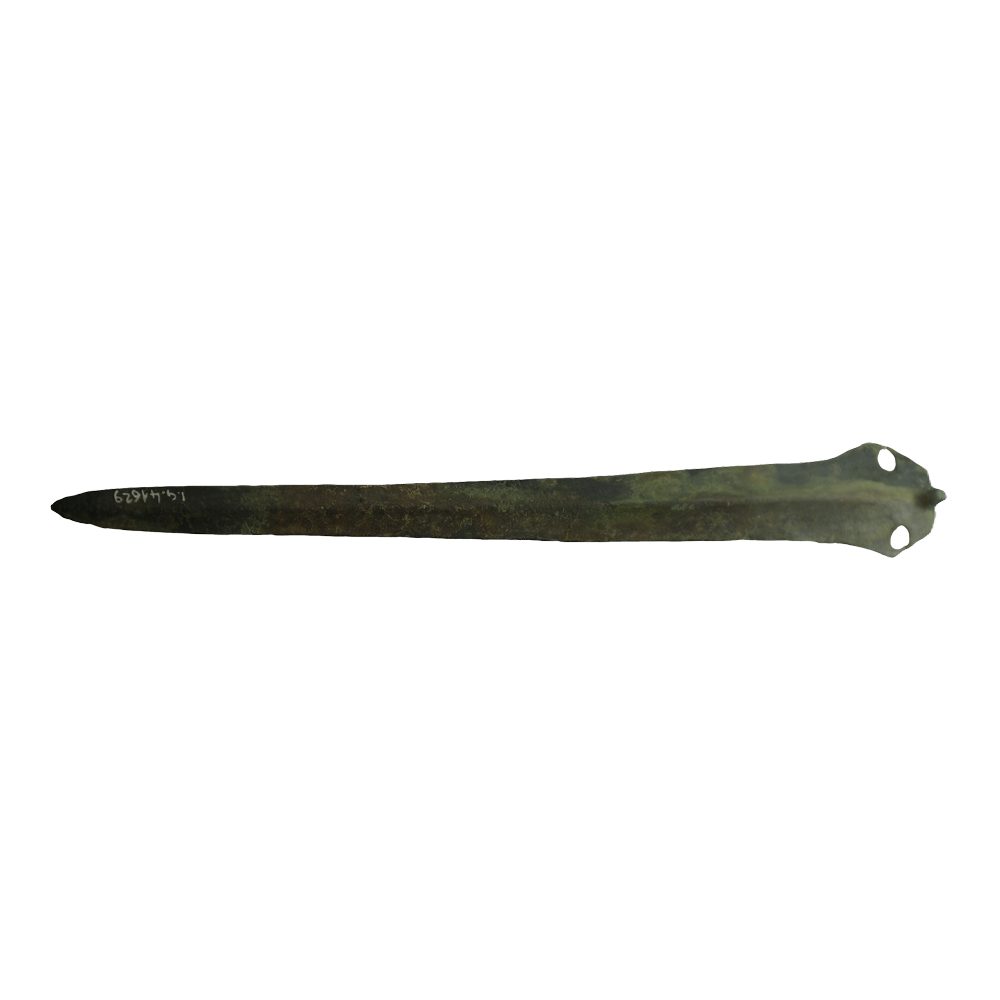
Short thrusting sword with an expanded trapezoidal hilt base pierced by three rivet holes, one of which still retains the original rivet.
| Teca |
Display case swords |
|---|---|
| Collocazione | Museum of the Bacchiglione River, Castello di San Martino della Vaneza, Cervarese Santa Croce (Province of Padua), Room XXX, Display case XXX |
| Data | 15th–14th century BC (Middle Bronze Age) |
| Materiale | Bronze |
| Misure | Length 22,2 cm - Width 2,8 cm |
This short bronze sword comes from the territory of Cervarese Santa Croce and was recovered in 1977 from the Bacchiglione River, in the Trambacche area near Creola, thanks to the intervention of divers. It is currently preserved at the Museo del fiume Bacchiglione, in the Castello di San Martino della Vaneza, and can be dated to the 15th–14th century BCE, during the Middle Bronze Age.
The weapon is compact, with a length slightly over twenty-two centimeters, and features an expanded trapezoidal base with three circular holes. One of these still retains the original metal rivet, an element that allowed the blade to be firmly attached to the handle, made of organic material. The blade, clearly distinguished from the base, has a rhomboid cross-section and is marked by a pronounced central ridge, which ensured strength and effectiveness. From the base, the blade gradually tapers toward the tip, highlighting its function as a thrusting weapon.
From a typological perspective, this artifact demonstrates an important phase in the evolution of weapons during the Bronze Age. In the earliest examples of swords and daggers, the base of the blade was usually circular or straight; during the Middle Bronze Age, however, the trapezoidal base gradually became widespread, as in this case, accompanied by an increasing number of holes for attaching the handle, generally between two and four.
At the same time, new solutions for the handle were developed: alongside handles made entirely of organic material, handles with metal tangs appeared, typical of certain types such as Sauerbrunn and Cetona, eventually leading to solid full handles. This short sword thus represents a significant step in the technological evolution of Bronze Age weapons, as well as a valuable testimony of deposition practices in riverine environments, which were common along the Bacchiglione during the Bronze Age.
Bianchin Citton, E.; Malnati, L. 2001, Protostoric Bronze Finds from the Rivers of the Veneto, in G. Cresci Marrone and M. Tirelli (eds.), Horizons of the Sacred: Cults and Ancient Sanctuaries in Altinum and Eastern Veneto, Proceedings of the Conference (Venice 1999), Rome, pp. 201–202.
The base of the blade in Bronze Age swords underwent a clear functional development. In the earliest examples of swords and daggers, the tang was either rounded or straight-edged. During the Middle Bronze Age it evolved into a trapezoidal shape—such as in the present specimen—with two to four rivet holes for attaching the hilt.
Metal-hilted forms with a flanged grip plate (as in the Sauerbrunn and Cetona types) also appeared during this period, followed later by solid-hilted swords cast in a single piece.
Cookie policy
Su questo sito utilizziamo strumenti propri o di terze parti che memorizzano piccoli file (cookie) sul tuo dispositivo. I cookie sono normalmente utilizzati per consentire il corretto funzionamento del sito (cookie tecnici), per generare rapporti sull’uso della navigazione (cookie statistici) e per pubblicizzare in modo adeguato i nostri servizi/prodotti (cookie di profilazione). Possiamo utilizzare direttamente i cookie tecnici, ma hai il diritto di scegliere se abilitare o meno i cookie statistici e di profilazione. Abilitando questi cookie, ci aiuti a offrirti un’esperienza migliore.